Building Business Relationships

How to develop your supplier relationships

Developing good connections with suppliers—sometimes called supplier relationship management—is critical to business success.

Businesses are increasingly relying on suppliers to help reduce costs, innovate, improve quality and reduce lead time. Good relationships with suppliers can provide a competitive advantage.

In fact, the most successful Canadian entrepreneurs rank relationships with suppliers as their most important business relationships, according to a recent survey of 1,000 Canadian small and medium-sized businesses.

Nearly one-third of the most successful firms said supplier relationships were critical to their success, in contrast to less than one-quarter of less successful companies.

Continuous effort needed

First-rate supplier relations require a continuous, long-term effort. Start by identifying the few vital suppliers that contribute to your company’s advantage over your competitors. You have a vested interest in their success. Focus on building and maintaining partnerships with them.

He divides the process into several steps:

  1. Evaluate all suppliers—Make sure they are the best ones for your business and that their products meet your needs. You want suppliers who are aligned with your strategy.
  2. Integrate key suppliers into your business—Learn how they operate and make sure your systems work seamlessly with theirs in areas such as invoicing and order fulfillment.
  3. Collaborate on quality improvement, problem-solving and product development—Work together to improve capabilities and adopt best practices on both sides.
  4. Measure performance continually—Have structured ongoing discussions with your key suppliers about how to improve.

Ultimately, the idea is to work together as partners so both sides prosper, sometimes companies focus just on the short term and only demand cost reductions from suppliers, rather than thinking strategically. That doesn’t help in the long run.

Do’s and don’ts of supplier relationships

  1. DO—Take a long-term approach to supplier relationships. Commit to shared prosperity and mutual development. Help suppliers boost their technical and problem-solving capabilities.
  2. DO—Understand in detail how your key suppliers work. See how they operate and learn their culture to ensure mutual trust and strong partnerships.
  3. DO—Periodically evaluate the performance of key suppliers with scorecards, and periodically scan the market for better and/or more cost-effective alternatives. While you want to nurture strong relationships with suppliers, you don’t want to become captive to them.
  4. DON’T—Focus only on short-term goals, such as cost-cutting. Don’t insist on unreasonable payment terms or pressure suppliers to assume the cost and risk of holding the bulk of your inventory.
  5. DON’T—Focus your efforts on all your suppliers. Save your special collaboration for only a handful of key strategic partners. Anything more is unsustainable.

sample-post-4

Will I have enough money to retire?

The #1 question people have about their Financial Health:

Do I have enough money to retire?

There are variations of this question:

“Will I have enough money to retire?” or “Can I retire on time?”

They all lead to one glaring issue:

You’re not confident about your advisors’ process.

A Second Opinion Portfolio Review will provide you with a clear unbiased direction.

Schedule Your Second Opinion Review

Free, No Obligation

Before you consider meeting with me here are a few things to consider:

Sources of Income

There are very few employers that provide Defined Benefit Pension Plans. This means your retirement income will have to come from your own personal investments.

The dark blue on the chart below represents Pension Income. If you don’t have a Defined Benefit Pension Plan through your employer, what is your plan to replace $30,000 of annual pension income?

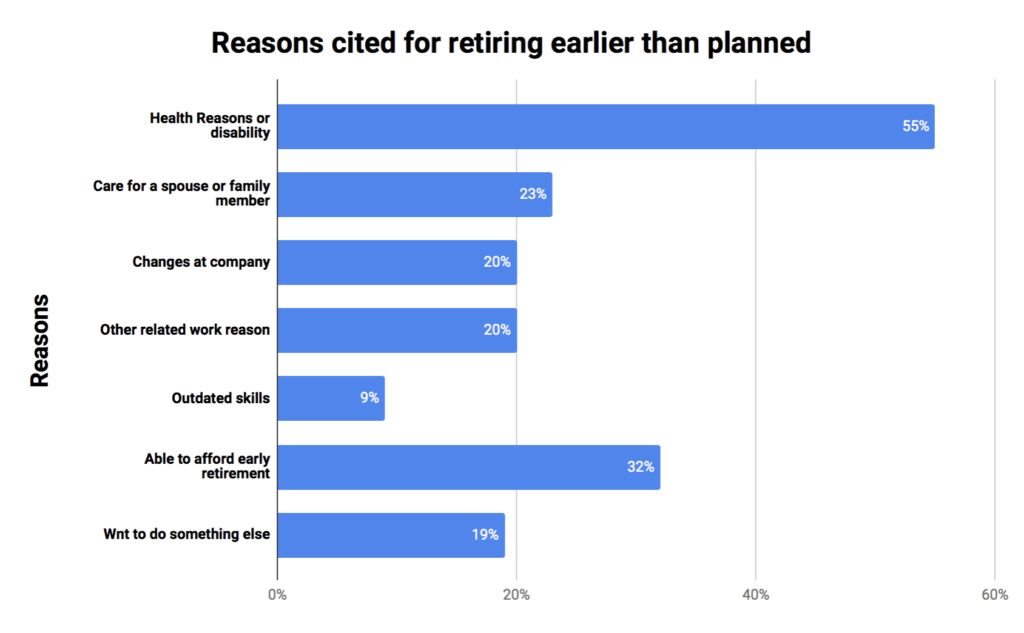
Reasons why people retired earlier than expected

We are conditioned to believe retirement starts at 65.

Statically speaking it doesn’t. More than 1/2 of the people who state they will retire at a certain age don’t.

The table below illustrates why.

Your financial plan should address these facts.

Do you want to know if you’re on track?

Fund Fees

Not all funds are equal

How to increase your rate of return without increasing risk.

During a recent Second Opinion portfolio review, I compared a portfolio a couple had with a bank against my recommended portfolio. They immediately made a comment about their MER (management expense ratio or cost to investing) was higher than expected.

Another area was the overlap of funds in their portfolio. It’s very common during the Second Opinion portfolio review to find this. Examples of this are 2 Canadian balanced funds or 2 Dividend funds. Think of it as having a McIntosh & Red Delicious apples. Their both apples with slightly different crunches, but essential both apples. What you want is the best apple, best pear, best banana, etc. A basket of the best investments, with as little similarity as possible and all designed with a goal in mind.

The recommended portfolio had funds within their risk tolerance, very little overlap and a lower MER. More importantly, the portfolio was designed through Goal-Based planning.

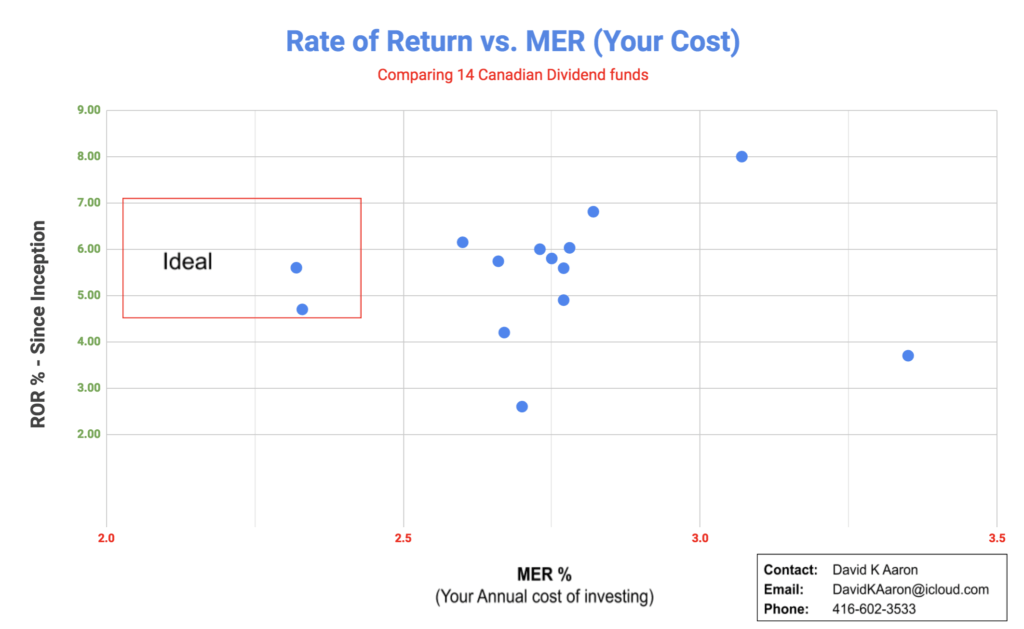
Comparing 14 Canadian Dividend funds

The chart below compares 14 Canadian Dividend funds against their cost (MER) and their Rate of Return (since inception). Ideally, you want to pay the least amount of money (fees & charges) with the highest return (within your risk tolerance). The question is: Do you know what you have and how much it costs?

Fund Comparison

I want to know which funds above have the lowest fees.

Low fee funds

Fees Matter – Are you with the right company?

Why pay more for your investments! While you can’t predict returns, you can control the fees you pay.

Ok let’s face it, the 5 year average return for the S&P/TSX (Cdn) Composite Total Return has been unimpressive (Only 4.1 percent before tax.)  One way to instantly improve your investment return is to examine which company has the lowest investment fee for a similar investment. 

Did you know that Canadians pay some of the highest fees in the world?

We’ve done all the work for you and looked at 10 investment companies. Want to know which company has the highest fee (Management Expense Ratio or MER) and which has the lowest?

Yes, I want to know how much I could be saving. Please contact me.

[wpforms id=”298″ title=”false” description=”false”]

David Aaron Wealth Management

5 Ways to save on investment fees


Canadians pay the highest investment fees in the world! 

The average management expense ratio (MER) in Canada for an equity fund is 2.37%. Translated another way, an investment portfolio of $100,000 would cost you about $2,350 to fees every year on average!

MER’s are not the only fee associated with investing although it makes up the majority of your costs. The MER is an embedded fee, meaning its “hidden”. It’s available to see on any fund perspective and its also mandatory for your advisor to disclose this in dollars ($) on your reports.

Quick note: Its mandatory for only mutual funds and not segregated funds. The recent changes to disclosure of investment fees only covers investments held through mutual funds. Segregated funds offered by insurance companies are exempt from this new disclosure. A great advisor will disclose fees on any investment.

Load options are not the only area of fees.  There are many types of fees such as:

$ Advisory and management service (AMF)
$ Redemption charges
$ Short term trading fee
$ Transfer out fee
$ Account closing fee
$ Guarantee fees
$ Unscheduled redemptions and courier fees
$ Other service fee

Load options commonly referred to as “sales charges”:

Front-end Load: This is a fee or initial sales charge by the investment firm for selling the fund. It can be anywhere from 0-5% and is taken from your investment prior to purchasing a fund. The fee may be negotiable. Example: a $100,000 deposit with a 3% front-end load will result in $97,000 deposited to the fund and $3,000 going to the investment firm. The investment firm gives a portion of the $3,000 to the advisor who sold you the fund.

Advantage: If at some point you choose to move your investment to another company you will not experience any sales charge fees to move your money. This is assuming the fund cannot be moved in-kind to the new institution (often it can be). There may be other fees associated with moving your money such as transfer fees or account closing fees. Ask your advisor if they are willing to absorb these fees.

Disadvantage: Front-end load fees from1-5% means less money is being invested.

Back-end Load Option: Many companies are doing away with Back-end Load charges or Deferred Sales Charges (DSC). While its been a massive part of revenue for investment companies, its also been the biggest area of contention among investors. Largely because many advisors didn’t disclose the fee. When investors choose to move their money to another institution they’re hit with a  DSC fee as high as 5.5% ouch! DSC example: on a $100,000 deposit, the client is charged a 5% DSC fee. This fee is only charged to the investor if they withdraw money (above a certain annual amount between 10-20%) or move their investment to another investment company. The fee is a declining schedule and may look like this:

Let’s say the investor moves their $100,000 (assuming no gain on the initial deposit) to another investment company in the 3rd year. The investor would incur a $4,000 DSC fee resulting in $96,000 going to the new investment company (also not assuming a transfer fee and account closure fee).

✚ Advantage: 100% of the investors’ money goes toward purchasing their investment.

Disadvantage: DSC fees charged to the investor to move their money to another institution. This fee can in many cases, dissuade an investor from moving their money away until the DSC fee expires after 7 years.

Low-Load Option: Same as DSC fee although the schedule is cut in half. Typically 3%, 2.5% 2%.

5 ways to save on investment fees, retire richer and way more happier

First above all, is to have your advisor provide full written disclosure of all the fees prior to your investment. Commonly known as the “Reason Why” letter, this document details the “reason why” you purchased the investment. It should list such items as:

  • what are your goal i.e. savings, retirement, capital purchase
  • timelines
  • risk tolerance
  • fees & commissions
  • who was present at the time of purchase
  • analysis of why the particular fund was used
  • analysis of your current situation and desired outcome

options to lower your investment costs:

  1. Exchange Traded Funds (ETF): These investments typically have very low MERs and are readily available through online trading accounts, banks & brokerages. Whatever your investing in say a mutual fund can easily be found in an ETF.
  2. Dividend Reinvestment Plan (DRIP): Generally speaking, this is for long-term investors who favour high dividend producing stocks, and regularly reinvestment opportunities, a DRIP is an excellent low-cost option. DRIPs allow investors to purchase stocks directly through a transfer agent vs. stock broker thus eliminated the trading fee.
  3. Trade less often: Sounds odd I know however, the idea here is to find core investments that suit your investment goals. Core investments are changed with less frequency as other investments.
  4. Low-cost advice & management: As DSC fees are being fazed-out there is an increasing shift to fee-for-planning. Depending on your assets under management (AUM) these fees can range from 0.25-1.5%. The range depends on the scope of work your asking the advisor to perform i.e. Portfolio Management vs Financial planning.
  5. Taxes: Talk with your advisor and tax professional about ways to mitigate the tax on your investment gains and also whether the fees can be deducted at tax time. 

Want to know which companies have the highest fees?

We’ve done all the work for you and looked at 10 investment companies. Want to know which company has the highest fee (Management Expense Ratio or MER) and which has the lowest?

No Load Option: This load option is in favour and widely used in banks and brokerages. This isn’t to say there are no fees as there are many fees as mentioned above. No load is similar to Front-end load in that the fee charged is 0%. There are zero dollars charged to your investment meaning 100% of your money goes to the purchase of your fund and there are no fees to move your money away other than account closing fee and transfer fees.

Yes, I want to know if I’m paying the highest fees! Please contact me.

[wpforms id=”298″ title=”false” description=”false”]

Estate Planning David K Aaron

Questions to ask your financial advisor

Use these questions to find the right financial advisor for your needs

Finding the right financial advisor to work with has become just as challenging as trying to pick the right investment. Not all financial advisors are created equal so you have to learn to interview them.  Here are a few questions to help you determine the right advisor to hire.

Questions about the advisor:

  •     How long have you been in business?
  •     Do you specialize in anything?
  •     What do you like most about being an advisor?
  •     What educational designations do you have?
  •     What makes you different from all the other advisors that are out there?

Questions about their business:

  •     What does your organization look like?
  •     How many clients do you have?
  •     What does your ideal client look like?

Questions about products and services

  •     What are your product biases?
  •     What kinds of products do you sell?
  •     What kinds of products can you not sell?
  •     What services do you provide?
  •     What is your area of expertise?
  •     Do you do financial/retirement plans?

Questions about investing:

  •     What is your investment philosophy?
  •     What do you do for investment research?
  •     How do you choose investments to buy?
  •     When do you sell investments and why? 
  •     What is your track record?
  •     Do you have an example of a model portfolio?
  •     How do you measure or judge performance?
  •     Do you use performance benchmarks?
  •     How do you measure risk?
  •     How do you define risk?
  •     What measures do you use to evaluate risk?
  •     What is your position on taxation of investments?
  •     Will I have an investment plan?
  •     What will that plan entail?
  •     What is the process I will have to go through?
  •     Do you use investment policy statements?

Questions about compensation and service:

  •     How do you get paid?
  •     What fees do you charge?
  •     What total fees will I have to pay directly or indirectly?
  •     How often will you report back to me?
  •     What is your preferred method of communication?
  •     What is your service proposition?
  •     How often will my portfolio be reviewed?
  •     Do you have client references?
  •     Ask them to explain a concept to you?
  •     When is the best time to invest?
  •     What is the best way to save money on tax?
  •     Can you explain the difference between RRSPs and TFSAs?

Developing an interview process:
There are a lot of questions here and you may not want to ask all of them or it may be a half-day meeting.  Pick some questions that are important to you and type them out in a format where you can take notes.  Take this document into the interview and let the advisor know you have some questions and take notes as the advisor answers them.  As soon as you are done the meeting, take a moment in private to rate how the advisor did with each of the questions.  I like to use a scale of 1 to 10.  It’s important to do this right away when you get to your car because everything will still be fresh in your head.

Here are the three most important questions of all:

  •     Can you see yourself developing a long term relationship with this advisor?
  •     Do you trust this advisor?
  •     Can this advisor fulfill your financial needs over the next 5 to 10 years?