
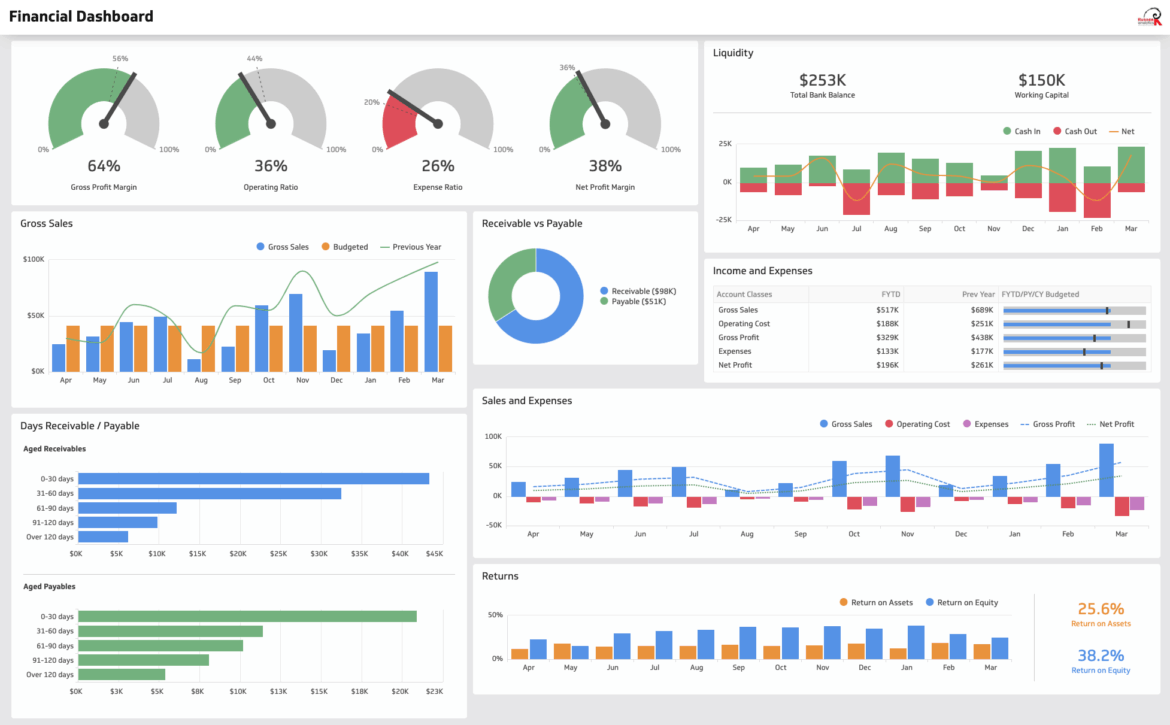
Financial Dashboard

Financial dashboards

Find out how your business is doing and quickly reveal variations that might require corrective action with these important indicators.

Monitoring your cash flow is one of the best ways to improve the financial health of your business. It could mean the difference between going through some financial bumps and having to close your business.

Creating a spreadsheet and updating it regularly will provide you with the data you need to create your financial dashboard—a group of indicators used regularly to monitor your company over time that will tell you how you’re doing and quickly reveal variations that might require corrective action. (Accounting software often offers a dashboard as part of its cash flow management tools.)

For better overall cash flow analysis, always start by making financial projections that reflect expected monthly inflows and outflows, including major anticipated purchases and financing. Then, use your spreadsheet to compare your projections to actual results.

Cash flow indicators typically found on a dashboard include:

  • Actual sales and sales in your pipeline
  • Average days collection (for your accounts receivable) and average days payable outstanding (to your suppliers)
  • Inventory outstanding

Other indicators will depend on what type of business you are running.

Here are three important metrics you might want to consider also including on your cash flow dashboard.

1. Cash on hand

Some businesses monitor this number on a daily basis. If cash on hand falls below your target, alarm bells should go off and contingency measures taken.

Continuously monitor how much cash you have on hand and check it against the target set when you did your financial projections. Your quick ratio and your working capital ratio will tell you if you have enough cash on hand to meet short term needs.

2. Cash conversion cycle

Tracking this metric over time will help you identify sources of cash flow problems and measure progress in tightening your cash flow management. The lower this number, the better—it means you have more cash on hand to generate additional returns and/or reduce your line of credit.

To determine your cash conversion cycle take the number of days of inventory outstanding (how long it takes on average to sell your inventory), then add to it the number of days receivable outstanding (how long it takes your customers to pay you), then subtract the number of days payable outstanding (how long it takes you to pay your bills).

Formula

Cash conversion cycle =

Days inventory outstanding + Days receivable outstanding Days payable outstanding

3. Gross profit

Gross profit is a great starting point for determining the value of every sale and making pricing and promotion decisions.

It’s important to keep an eye on it since a gradual decline could mean future trouble for your business.

Your gross profit (or gross margin) is the money you make directly from selling products and services, minus the cost of sales. It doesn’t include indirect cost of sales such as rent and marketing.

You can calculate your gross profit as a percentage of revenues using the following formula:

Formula

Gross profit margin = Gross profit / Revenues X 100

Cashflow

5 steps to plan your cash flow in 2020

Financial projections will help you anticipate your cash flow needs

It’s the start of a new year, and you’ve got big plans for your company—an expansion or a major equipment purchase.

How will your plans affect your cash flow? Will you need financing, and if so how much?

These are typical questions to ask as part of your company’s annual financial planning.

Many neglect financial projections

But a surprising number of entrepreneurs fail to make financial projections for their company. And the result can be serious, unexpected trouble.

Making cash flow and other financial projections each year is a vital tool for keeping your business healthy and on a sustainable growth path.

The idea is to have a reference you can review through the year, so you can make adjustments as needed. Without this, you’re basically leaving everything up to chance.

How to make financial projections

Here are five steps to creating and using financial projections to guide your business.

1. Plan your year

First, think about what you want to accomplish over the next 12 months. This should be based on your strategic plan for your business.

With a clear idea of what you want to achieve, start estimating your annual expenses and consider the additional costs you will incur to implement your business strategy. These expenses should be added to the costs of running your day-to-day business, such as:

  • payroll
  • rent
  • utilities
  • interest
  • loan repayments

Also, be sure to consider anticipated big-ticket items, such as buying a new truck, redesigning your website or updating your computers.

Next, estimate your annual sales and think about the effect your decisions will have on your cash flow forecast. Make sure you take into consideration your credit policy and when your customers pay to ensure your business has enough cash throughout its business year.

2. Make projections

Based on past experience and your plans for the coming year, prepare these three documents.

  • A projected income (profit-loss) statement—Projected revenues, costs, expenses, taxes, etc.
  • A projected balance sheet—Assets, liabilities, equity.
  • Monthly cash-flow projections—Accounts receivable, accounts payable, investments, financing, etc.

It’s helpful to have different projected scenarios (optimistic, most likely and pessimistic) so that you can anticipate better the impact of each one.

3. Arrange financing

With your projections in hand, determine financing needs for the coming year and discuss them with your bankers and other financial partners.

The start of the year is a good time to arrange any needed credit lines or business loans. Working out your financing ahead of time improves your odds of getting approval and helps ensure the best terms.

If you come to your banker and tell them you need a $2 million loan next week, most probably he or she won’t be able to help you. Bankers don’t like surprises. They lend you money when you can show you understand what you’re doing.

Also, don’t make the common mistake of dipping into your working capital for long-term capital investments because you may end up facing a cash crunch. It’s better to use long-term financing for such projects.

4. Monitor and adjust

Finally, review your projections each month against the actual numbers to see if you’re on track. Variances can flag trouble spots in your business. Take an even closer look each quarter. Make any needed adjustments to your operations or changes in your planning.

5. Get help

Depending on your in-house resources, consider seeking outside help in creating your financial projections and monitoring your progress through the year.

Strategic Planning

Strategic planning: frequently asked questions

Some entrepreneurs might not see the benefits of strategic planning or know how to proceed.

Here are answers to some of the most common questions and concerns raised by entrepreneurs about this important tool.

Question: My company is small. We don’t have a lot of money. Isn’t strategic planning just for bigger companies?

Answer: That’s a common misconception. All companies, large and small, can benefit from planning for the longer term. It can help you weather today’s challenging markets, diversify and proactively pursue the best opportunities.

Strategic planning doesn’t necessarily mean producing a big, highly detailed document. It can be done on a smaller scale at a reasonable cost for businesses of any size.

Question: How can I find time for strategic planning when I’m already swamped with the day-to-day business of running my company?

Answer: Taking the time to work on your business instead of in your business will pay big dividends, including helping you be less swamped day to day. A strategic plan can help you focus on important issues, make decisions, delegate, reduce errors and not waste so much time putting out fires.

Question: Won’t strategic planning cause a lot of disruption to my business?

Answer: Planning for your business may lead to changes in your company, but they will most likely be positive changes. The end result should be better decision making, wiser use of resources and improved growth and profit margins.

Also remember that change will happen anyway, regardless of whether you develop a business strategy. A plan will help you anticipate change and focus on the best opportunities, rather than reacting and letting change take you by surprise.

Question: How can I plan long term when the future is so uncertain and I have no idea what will happen next week, let alone several years out?

Answer: Planning is needed precisely because the future is uncertain. The information you have today can be used to make reasonable forecasts of what the future might hold. Thinking about the future helps us plan what to do in various scenarios so we can be more ready for whatever it brings.

Question: Everything is fine with my business, so why would I need a strategic plan?

Answer: It’s common for entrepreneurs to feel their business is doing great—until a sudden change takes place that disrupts or even imperils their company. Planning strategically can help you prepare for such changes and stop flying blind.

Question: Why should I do strategic planning when I already know I need to grow by investing more in sales and marketing?

Answer: Sales and marketing without the right strategy won’t necessarily bring you success. They could just increase your costs. And even if your sales go up, will you sell the optimal products at the best margins to the right customers? Will you have financing, operations, and distribution in place to handle the sales increase?

Question: Why do I need a plan when I already talk regularly about our business goals with my team?

Answer: Even if you discuss your goals internally, a strategic plan gives your entire team a clearly articulated line of sight to those goals.

Recession Proof Business

How to thrive during a recession

Too many companies go into hibernation when times are tough. They cut costs, conserve cash and act as if they’re on the verge of bankruptcy when, in reality, their balance sheet is still solid enough to reposition the firm.

Whether it’s a recession or a downturn in your particular industry, don’t assume you can wait until the storm has passed before taking action. It may be too late.

Use these setbacks to get aggressive. It can be a great opportunity to build market share.

One entrepreneur’s experience

Auto parts maker Warren Industries, for example, had to endure some painful body blows at the beginning of the 2008 recession. The troubles of General Motors and Chrysler contributed to a 45% drop in sales.

Despite the slowdown, CEO David Freedman wasn’t about to start circling the wagons.

In addition to bolstering its engineering capacity and developing proprietary technologies, the company took advantage of the economic downturn to negotiate better lead times and prices with hungry suppliers.

It also purchased machinery and other equipment at bargain-basement prices.

Move up the value chain

Even before the recession, Freedman and his team realized it was no longer good enough to simply stamp out and assemble other companies’ parts. They needed to move up the value chain by adding engineering expertise that allowed them to develop their own proprietary products.

The result was transformational. Warren Industries evolved from a Tier 2 company making other companies’ products into a Tier 1 supplier developing innovative and highly engineered products that it can now sell directly to customers.

6 ways to go on the offensive during tough times

  1. Reinforce relationships with clients and suppliers. Reassure clients you’re a dependable supplier who will be there for the long term and confirm that your suppliers are stable.
  2. Boost operational efficiency. In times of crisis, employees are open to change and galvanized to help.
  3. Rethink your business model so that the offering is truly differentiated.
  4. Attend industry trade shows. They’re a great way to make new contacts, develop new markets and find out what’s happening in your industry.
  5. Understand the services available from organizations like BDC and Export Development Canada. They can help grow a business in difficult times.
  6. Form an advisory board. It can be a wonderful source of fresh ideas and bring skill sets that are often out of reach for many small businesses.

Advisory Board

How to form an Advisory Board

Why should I bother with an advisory board?

There’s increasing recognition that effective advisory boards provide excellent support to business owners for a minimal cost. Instead of asking why you should have a board, you should be focused on the best ways to establish one and how to find qualified advisors.

Effective boards can bring huge benefits to small and medium-sized businesses, but for that to happen, you need the right people.

Staffing your board

Advisory boards exist primarily to add value to the business. This means ideally, they should be staffed to complement the abilities of the entrepreneur who runs it.

Before seeking out potential candidates, you should do a quick SWOT analysis to understand your company’s strengths and weaknesses, as well as the opportunities and threats it faces. That makes it easier for companies to identify areas in which complementary skillsets are needed.

Trust is also a key factor. To provide valuable input, advisory board members need to know as much as possible about what is going on in the business.

The more an entrepreneur trusts his advisory board members, the more open he is likely to be with them. They will be in a far better position to provide constructive advice.

The ability of a potential board member to diplomatically challenge an entrepreneur’s ideas and to help the company navigate through periods of growth and change is also highly prized.

What’s in it for the advisors?

While listing the ideal qualities entrepreneurs want in advisory board members is a good start, attracting qualified candidates is much harder. One major problem: Entrepreneurs don’t generally have the budget to pay the fees that larger companies do.

As a result, companies are best off trying to recruit candidates who are not in it for the money, but rather have a genuine desire to see the owner do well.

Potential advisory board candidates can often be found among the owner’s personal contacts. You probably know the sort of high-calibre business executives, university professors or professionals who would make ideal advisory board members.

And don’t forget the growing numbers of retired business executives. Many remain active and interested in business and are itching to make a contribution by attending advisory board meetings and offering their experience, wisdom, and advice.

Formal boards of directors may be required

The stakes rise considerably when businesses shift from using advisory boards to statutory boards of directors.

This usually occurs when businesses either transform into public companies or when they take on investors—such as venture capital funds or private equity firms—who want board representation to represent their interests.

Members of statutory boards will generally have slightly different profiles than advisory board members. You will generally favour someone with “C”-level management experience. That means a Chief Executive Officer, Chief Information Officer, Chief Financial Officer or someone with equivalent experience.

Recruitment can be difficult

In addition, not all skill sets are easily recruited.

Because of the influence that complex Sarbanes-Oxley corporate governance legislation guidelines have had on reporting standards, audit committee members are increasingly in demand.

Entrepreneurs faced with more stringent requirements for director qualifications and the potential for liability will need to follow a formal recruitment process and offer higher compensation.

Trade Show

Trade shows: 6 ways to find potential customers

Use these tips to get the most out of your trade show investment

Trade shows provide face-to-face contact with people who are looking for products, expertise, and solutions.

So how can you tap into this rich source of potential customers? What investment is required and what return on investment can you expect?

Veteran trade show consultant Jonathan Denman shared these six tips.

1. Calculate what it costs

“Booth rental is really only part of the total cost of exhibiting,ˮ Denman says. “There’s travel to the show, customer hospitality, and many other expenses.ˮ

Denman is a member of the CAEM (Canadian Association of Exposition Managers) Hall of Fame. The association provides the following cost breakdown for a typical industrial trade show. This data can be used to estimate your total show cost.

Exhibit space (the rental of space)29%
Exhibit design (the design, rental, construction of a booth)18%
Show services (power, telephone, table and chair rentals, etc.)18%
Travel and entertainment (the cost of sending staff to the show)13%
Shipping (shipping your booth, products, literature, etc.)12%
Promotion (pre-show promotion, literature for the show, etc.)9%
Other1%

So for instance, if booth rental costs $5,000, your total cost is likely to be around $17,250. Sounds expensive. But let’s say over three days you discuss with and acquire contact information for 150 good prospects, your cost of acquisition per lead is $115. You can further apply your conversion rate to give you an idea of your cost per sale. If your conversion rate is typically 10% (10 leads to get one sale), then you can expect to have 15 sales at a cost of $1,150 which may or may not be unreasonable for your product.

2. Find the right shows

“Every year there are between 14,000 and 15,000 trade shows across North America,ˮ Denman says. “You need to focus on specific shows that attract the right audience.ˮ

“Given enough time, the Canadian Trade Commissioner Service can sometimes provide you with market information and contact lists for the geographical area covered by a trade show,ˮ Denman advises.

The Canadian Trade Commissioner Service maintains a list of major trade events around the world. The Government of Ontario also maintains a list of international trade shows.

3. Design your booth for maximum impact

You may not have a big budget, but what you do have should go toward maximizing the impact of your back-wall signage. “The sign at the back should take up 70% of the back wall and feature your company name and what your company does,ˮ Denman says.

  • Don’t clutter it up with small photos and descriptions. Choose one good image to blow up and make sure your company name can be read from afar.
  • Keep your table and chairs away from the back wall and make sure there’s enough room for visitors to move around inside your booth.
  • Try to get as much frontage as possible and try to be situated near high-traffic areas.
  • If you have the budget for a big booth, you may be able to include a quiet corner or even an office to negotiate with potential customers.

4. Make sure you have enough staff

Show organizers should be able to provide you with the estimated number of visitors to the show. From that, divide the number of visitors by the number of show hours. That gives you the average hourly flow-rate, which can help you decide how much staff you need.

It’s really difficult for one person to engage more than six visitors per hour in meaningful conversation. So, plan accordingly and remember there will be peak times when you may be swamped, and there will be times where there are no visitors at all.

“The challenge for the small exhibitor is they will only be able to have two or three people managing the booth,ˮ says Denman. “They can only talk to 12 people each hour. If the flow rate is 600 people per hour, they’re missing out on important opportunities.ˮ

5. Staff your booth with experienced people

This isn’t a typical sales environment. “Most salespeople are trained for one of three things: Either they’re on the road, or on the phone or in a showroom,ˮ Denman says. “Trade shows require a different approach. ˮ

“You’ve got to have an opening line… something like ‘have you seen our product before’ or ‘are you familiar with our company’… something to draw visitors into a conversation.ˮ And once you’re conversing, you have to have something to say. “Unfortunately, many exhibitors staff their booths with junior people who may not know a lot about the company or its products.ˮ

“Imagine a buyer who’s an engineer: This person needs technical advice. They’ll be disappointed if the only information they can get is a pamphlet that they could have downloaded from your website.ˮ

So it’s better to staff your booth with technically proficient, senior people.

6. Always follow up

Remember, at the beginning and end of every sale is a person who wants to feel good about his or her purchase: They may want a deal but what they’ll remember is the way you made them feel.

Before the show, you can demonstrate you’re thinking of your customers’ needs by sending a personalized invite to the show—perhaps with a redeemable beverage ticket.

After the show, a good way to show that you’re working on finding them a solution is by sending a follow-up email within 72 hours.

Trade shows can be cost-effective venues for establishing face-to-face relationships. A little forethought and preparation will go a long way to converting booth visitors into buying customers.