

Toronto Wealth Management

Local marketing & advertising strategies

According to the Small Business Administration, a third of businesses with employees don’t survive beyond two years. But once you’ve made it through the difficult startup period and your business is on sound footing, it’s time to think about expanding locally. 

Building out your business can lead to sales growth that allows you to stay ahead of the competition. Expansion can be risky and increase debt, and it takes time and resources. But the potential rewards can be worth the effort. With sound planning and execution, it’s a manageable task. A sound marketing strategy is key, allowing you to build awareness of your brand in the public eye. That can even lead to an increase in customers. 

Conduct market research and formulate a plan

Start by conducting market research. While this may sound costly or complicated, it can be as easy as talking to your customers about your products and services or asking them to complete a short survey. For Internet companies and e-tailers, there’s free or inexpensive online software that enables you to email questionnaires to your customer list. 

Once completed, use the valuable customer feedback to assemble a marketing plan, such as what the Small Business Administration outlines. The information will help you understand your target market and your competitive position within that market. You’ll be able to better tailor your message to your customers while choosing the best medium for reaching them. 

Also, a marketing plan will help you stick to your overall growth plans and keep you on budget and on track for timely, prudent spending of your marketing resources.

Head online for local advertising

Your company website will serve as one of your primary marketing tools. It’s a virtual storefront for online customers, whether you’re selling products or services. Ensure your site is up to date, easy to navigate and has a design best representing your business. If a large portion of your business occurs online, consider creating a mobile app to allow your customers to shop with their smartphones, or at least develop a responsive, secure website. A well-made app can make for an easier, more interactive shopping experience.

With a company website and app, you can take advantage of marketing opportunities by adding navigation software that allows you to track a customer’s visit to your online business. You can automatically send related product suggestions based on their searches or create online tools to deliver coupons, special offers or one-time sales promos. Offering loyalty or club cards can encourage return visits.

Free enterprise and social media

One sure way to stay on budget is to take advantage of as many free marketing opportunities as you can. For instance, Google My Business allows you to set up an account listing vital business info, including your address, phone, hours of operation, website link, business description and even a photo. This ensures the correct details appear in online searches and can give your business a boost in search rankings. 

Establish accounts on popular social media platforms such as Facebook, Twitter and Yelp, which offer excellent opportunities for engaging with customers and advertising special events or offers. It’s important to check on the sites regularly and post updates on a consistent basis. Another strategy for building traffic to your website is to add a blog where you can post news, tips and articles on subjects related to your business.

Paid media

Traditional marketing methods have long helped owners grow their businesses and should be an important consideration for any local marketing strategy. Although marketing is increasingly shifting to the internet, purchasing an ad in a local newspaper can still be the best way to reach a target audience if you run a retail outlet such as a furniture store.

To promote specialized products, consider advertising in specialty magazines or trade publications. If you want to better gauge the ad’s effectiveness, include a coupon or discount for subscribers that they can redeem at your business.

A similar strategy is to buy local advertising spots on a TV or radio channel. Your local station’s ad sales team should be able to provide information on its listeners, including detailed demographics and audience size at each point in the day, to help you choose the best program and time slot for your ad. Flyers and coupons sent via direct mail are another option for businesses interested in reaching a wide audience.

Paid digital marketing

Digital advertising is a logical part of any marketing plan. It can seem complicated, but a well-placed digital ad can reach the largest audience in the shortest amount of time. 

Consider advertising with the online version of your city newspaper or another local news website or popular blog. For a more targeted approach, advertising through business services that some of the largest social media companies now provide and some smaller ones can also ensure you reach a desired group. 

A Facebook business account allows you to pinpoint a demographic and choose the frequency of your posted ads. Likewise, Google AdWords targets your ads according to a user’s online searches. Both companies provide analytics for you to see precisely the effectiveness of your ads.

Whatever your approach to marketing and advertising, growing a business is an exciting time. Acquiring property, liability or business interruption coverage, can give you the confidence to focus on growth.

Marketing Plan

A step-by-step, no-nonsense marketing plan

Every marketing plan should include these five elements

Doing business without a marketing plan is like driving without a map. You may get to your destination—eventually—but you risk making time-consuming and costly errors along the way. You might be assuming there’s a demand for your product when there isn’t, for example. Your services might be priced too low. Or you could be venturing into a market that is impenetrable because of regulatory restrictions.

Marketing plan = confidence

The only way to start a business venture with confidence is to develop a good marketing plan—one that’s backed up with facts and research. This document clearly shows how you’ll attract customers to your product or service and persuade them to buy. The marketing plan also builds confidence with financial institutions, showing lenders that your business has a good chance of being successful.

Contrary to popular belief, a marketing plan is not a one-time effort destined to sit in a binder on your desk. On the contrary, it should be updated on a regular basis to reflect the changing needs of your business and customers.

There are many different models for marketing plans. Here are five essential ingredients.

1. Do a situation analysis

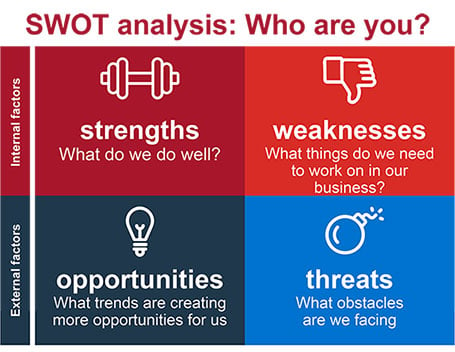
Many companies start with a SWOT analysis, looking at their firm’s strengths, weaknesses, opportunities, and threats. This involves identifying your competitors, understanding exactly how they operate and becoming familiar with their strengths and weaknesses.

Strengths are any competitive advantage, skill, expertise, proficiency, talent or other factors that improve your company’s position in the marketplace and can’t be easily copied. Examples are a well-trained sales team, low staff turnover, high consumer retention or low production costs due to superior technology.

Weaknesses are the factors that reduce your company’s ability to achieve its objectives independently. Examples include unreliable delivery, outdated production tools, insufficient marketing efforts and a lack of planning.

Opportunities are ways for your business to grow and be more profitable. These can include seeking new markets, managing technological change or addressing new consumer trends. You need to look at how your company’s main skills can be used to take advantage of these opportunities.

Threats are barriers to entry in your primary markets, such as a labour shortage, legislative hurdles or detrimental economic or political developments.

Parcours du client

2. Develop a target market profile

Demographic portrait

Here you want to demonstrate that you know your customers inside and out, including their expectations and their whims. Your profile should include basic demographic portraits that paint a clear profile of your clients. Look at characteristics such as age, sex, profession or career, income level, level of educational attainment and geographic location.

Estimated demand

You’ll want to provide research that shows the estimated demand for your product or service as well as the rate at which that demand is expected to grow. This builds confidence within financial institutions that your business has growth potential.

Purchase motivation

It’s also important to understand exactly what motivates customers to buy. Are your clients looking for savings or a way to simplify their lives, for example, or are they just shopping for pleasure? Ask yourself why they would buy your product or service. In the same vein, you may want to know what keeps customers away from your competitors’ products or services. Are they too costly? Do they lack something unique? These insights will help you develop a product or service that outshines the competition.

3. Set clear marketing objectives

Here you describe the desired outcome of your marketing plan with attainable and realistic objectives, targets and a clear time frame.

The most common approach is to use marketing metrics. For example, your market objectives could include:

  • total market share and segments
  • total number of customers and retention rate
  • the proportion of your potential market that makes purchases (penetration rate)
  • the average size or volume of purchases

4. Determine your marketing strategy

Once you’ve determined your objectives and targets, it’s time to look at how you’ll promote your business to prospective customers.

Strategies typically cover the Four Ps of marketing:

  • product
  • price
  • place
  • promotion

Your choice of marketing vehicles will be governed by the profile of your target market, so you need to understand how different vehicles reach different audiences. Don’t always assume you have to spend money on costly advertising. If you have a niche audience, for example, you can take advantage of low-cost marketing strategies such as e-mail.

The costliest options are usually advertising, sales promotions and public relations campaigns. Referrals and networking are lower-cost ways to reach customers. Digital marketing is a powerful strategy because it is inexpensive and effective in reaching target markets.

5. Create your financial plan

A marketing plan without financials has little clout. Financials can also be included in a general business plan.

One document you’ll need to produce is a budget and sales forecast. This doesn’t have to be complex; in fact, it’s wise to keep it simple. It may help to start with the following questions:

  • How much do you expect to sell?
  • What will you be charging?
  • What will it cost to produce your products or deliver services?
  • What will be your basic operating expenses? Be sure to include recruitment costs and salaries here.
  • How much financing will you need to run your business?

Answering these questions will help you determine your projected income and expenses.

A break-even analysis is another important step in developing your marketing plan. This analysis shows exactly how much you need to sell to cover your costs of doing business. If you can surpass your break-even point and easily bring in more than the amount of sales revenue needed to meet your expenses, you stand a good chance of making a profit.

Low-Cost Marketing

7 low-cost marketing strategies to implement now

You know it’s going to take a marketing push to meet your sales goals this year. But your budget is tight and you’ll need to use your imagination to make it. Where to start?

For many business owners, marketing doesn’t come naturally. They lurch from one tactic to another without a clear idea of whether the efforts are going to pay off in higher sales.

If that description sounds familiar, here are some time-tested, low-cost techniques to improve your marketing and help you reach your goals.

1. Conduct a survey

It’s critical to create a marketing plan before moving on to tactics. And the first step in developing a marketing plan is to understand who your target customers are and what they want from your company.

A good way to gain a better understanding of your customers is to conduct a survey about your products or services. If you can’t afford to hire a research company, do it yourself by creating a short questionnaire and recruiting existing and prospective customers to participate.

2. Pamper your existing customers

It’s typically five times as expensive to make a sale to a new customer as it is to an existing one. So make sure you’re not neglecting the people who already know and trust you.

Consider, for example, taking your best customers out to dinner or golf and using the opportunity to ask them about how to improve your business. You could also personally write to your top 10 customers to thank them and tell them they’re part of your new loyalty program or invite them to sneak preview your latest product.

3. Commit to online marketing

The Internet provides you with an inexpensive 24-hour virtual storefront. You can build relationships with prospective customers by offering them high-quality content on your site such as blogs, how-to articles, videos and a newsletter.

You can also extend your reach by using social media. One word of caution, however: If you’re not willing to devote six to eight hours a week of an employee’s time, you’re better off going with a simple, well-designed website.

4. Use all your real estate

Your building and surrounding land or sidewalk are great places to put up signs and banners. And don’t forget to use your vehicles as moving billboards. But remember: Your images and messages should focus on what you’re selling, not your company’s name.

5. Work at public relations

A media story about your company is generally much more valuable than an advertisement because of the credibility it confers on your business. But in this era of media cutbacks, it’s harder than ever to attract journalists’ attention. Keep in mind that they’re looking for a compelling story to tell. So help them by letting them know about your innovative product, unusual customer contact or high-stakes gamble that paid off. And keep at it—building relationships with the media will pay off.

6. Turn employees into ambassadors

Your employees are part of the community and have all sorts of contacts that could help you. How about inviting employees and their extended families to a fun event at your business? You may find you get new word-of-mouth business or hear about a potential new business partner. At the very least, your team will come back to work on Monday feeling energized.

7. Give back

By sponsoring a hockey team or participating in a charity drive with a cheque and a collection jar in your lunchroom or by the cash register, you’re not only doing your part for the community but also generating goodwill with customers and prospects.

Marketing Plan

Automate your digital marketing strategy

I’ve previously written about content marketing and its importance to small businesses trying to connect with customers.

An associated concept is marketing automation. It’s a term that gets thrown around a lot these days, but it remains very nebulous for many entrepreneurs. What exactly gets automated? And how does it work? Well, the answer can be confusing, to say the least.

At its most basic, marketing automation refers to software tools that do marketing tasks that small businesses might otherwise do manually.

These tasks include communications with customers and prospective customers via email or social media as well as measurement and tracking of information.

Ease your workload

One example of lessening your workload might be managing social media content on platforms such as Facebook, Twitter, and LinkedIn with a tool like HootSuite. With it, you can schedule posts ahead of time on all your social media properties from a user‑friendly dashboard.

Another example would be sending an automatic thank‑you email when someone submits a request to you, using the “contact us” form on your website. It’s easy and respectful.

These are very simple examples, but they show how marketing automation tools and strategies can save you time in managing communications and marketing campaigns.

Generate more sales leads

The idea of streamlining tasks is very much at the heart of marketing automation, but there is much more to it. Generating sales leads (or nurturing them) is also at the core of marketing automation.

There are many tools that allow you to communicate with prospective customers when they’re making buying decisions. They help you to put the right content in front of the right people at the right time.

Consider, for example, a customer relationship management (CRM) tool that allows you to identify all your customers in Vancouver who have purchased more than $1,000 in the last year. The tool also allows you to identify who in this group follows you on Facebook. Now you can use that information to target those customers with a Facebook ad offering them 10% off their next purchase.

Deliver segmented email content

Another example might be an email segmentation tool that allows you to send specific content in your email newsletter to subscribers based on what you know about their preferences.

So, let’s say a clothing retailer keeps track of the gender of his or her email recipients. The retailer can now send gender-specific content like deals on skirts and blouses to women and pants and shirts to men. Those individuals only see the things that interest them, ultimately increasing the chances that they will make a purchase.

Examples of automation tools

Here are some marketing automation companies that may be familiar to you.

These tools and many others like them help businesses collect better data and streamline marketing processes.

How much sophistication does your business need in its marketing automation software? That depends on the maturity of your digital marketing efforts and what kind of resources you can afford to devote to automation.

Use the right tools

Do you have a lot of social media followers and/or channels to manage? Do you have a lot of content to generate and publish in the course of a week? Do you have a lot of communication touchpoints with your customers? Are you collecting information from your customers on a regular basis?

The answers to these questions, and others like them, will help you decide what marketing automation tools you need.

Automation tools can provide awesome benefits to your business, but they don’t give you permission to take your eye off the ball. On the contrary, you always have to be reviewing your communications, customer feedback, and online data so you can continually improve your marketing efforts.

It’s not set it and forget it

For example, you have to be careful about the context in which you are automatically publishing content.

You absolutely do not want an automated tweet to go out at the same time that the Twittersphere is exploding over a major disaster or a horrific terrorist attack. Marketing on full autopilot without oversight is a bad idea.

Does your small business use marketing automation tools? Which ones? How are they working? We would love your comments.

Content Marketing

What is content marketing and why is it so important?

When an entrepreneur builds a new website, starts using social media or creates a blog, the same question always comes up: “What should I talk about?”

Creating good content is a challenge for many entrepreneurs who aren’t used to talking about their business or industry in a public forum. So what is content marketing and how do you do it?

It’s all about creating great content as a highly effective way to find new customers and retain the ones you have. Entertaining email newsletters, insightful blog posts, how-to videos, and other online content help you to build an audience and position yourself as an expert in your field.

People filtering out traditional ads

That’s especially important at a time when consumers are becoming increasingly adept at tuning out advertising messages both in the traditional media and online.

And that brings us back to the question of what you should talk about in your content.

A good place to start is to think about the challenges your customers ask you about every day. What are the questions you hear again and again? How do you respond? This can be the basis for a series of blog posts, how-to videos or a short eBook.

Pull back the curtain on your business

You can also pull back the curtain and talk about what’s happening inside your business. Talk about your wins but also be honest about the issues you’re grappling with and how you’re striving to improve for the benefit of your customers. You can also promote the charities you and your staff are supporting in your community.

You might also want to zoom out and discuss some of the big challenges that your industry is facing. It’s all grist for your content mill.

Let’s face it—we collectively have very short attention spans when it comes to the Internet. So you don’t always have to generate a high-production video or an 800-word article to get the job done. Often, a photo with a caption, a quick hit on your blog, a tweet or Facebook update will do.

Knowing your audience and their habits will help you to create the right content.

Reduce, re-use, recycle

There is a huge amount of content being created on the Internet every day. Some of it relates to your business, so why not tap into it?

Sharing good content from others can be just as powerful as creating your own. So if you find a good LinkedIn post, share it and add it to other relevant social media pages.

You should also go through your archives looking for material you can use. Is there an article you wrote for the local paper or a video you made for a presentation? You can reuse these online.

Make a content calendar

Still having trouble scheduling content creation into your day?

A content calendar can help. Pick regular dates on your calendar when you will be adding certain types of content and stick to it. It will help you and your team determine how often you should be posting content and keep you disciplined in doing the work.

Another frequently asked question is: Should I post on a regular schedule, such as once a week, or should I post as often as possible?

It’s important to be consistent

Well, there is no one answer to that. But certainly being consistent trumps communicating too often, (or more likely) too infrequently. It’s important to make sure you stay active in your channels. Don’t suddenly abandon your audience simply because you get busy or, worse, bored.

No one can create stellar content all the time. You may get out of the blocks fast and create a lot of messages over a short period of time. But remember, it’s a marathon, not a sprint and you will get tired.

With a little bit of organization and imagination, you’ll find content marketing is well worth your time and effort.