
Every marketing plan should include these five elements
Doing business without a marketing plan is like driving without a map. You may get to your destination—eventually—but you risk making time-consuming and costly errors along the way. You might be assuming there’s a demand for your product when there isn’t, for example. Your services might be priced too low. Or you could be venturing into a market that is impenetrable because of regulatory restrictions.
Marketing plan = confidence
The only way to start a business venture with confidence is to develop a good marketing plan—one that’s backed up with facts and research. This document clearly shows how you’ll attract customers to your product or service and persuade them to buy. The marketing plan also builds confidence with financial institutions, showing lenders that your business has a good chance of being successful.
Contrary to popular belief, a marketing plan is not a one-time effort destined to sit in a binder on your desk. On the contrary, it should be updated on a regular basis to reflect the changing needs of your business and customers.
There are many different models for marketing plans. Here are five essential ingredients.
1. Do a situation analysis
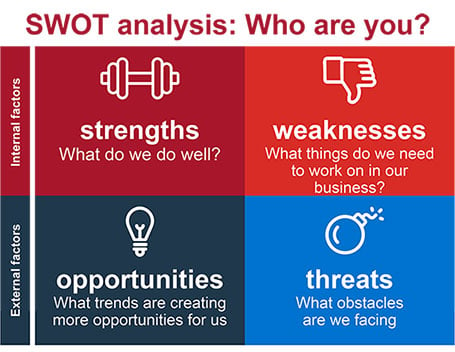
Many companies start with a SWOT analysis, looking at their firm’s strengths, weaknesses, opportunities, and threats. This involves identifying your competitors, understanding exactly how they operate and becoming familiar with their strengths and weaknesses.
Strengths are any competitive advantage, skill, expertise, proficiency, talent or other factors that improve your company’s position in the marketplace and can’t be easily copied. Examples are a well-trained sales team, low staff turnover, high consumer retention or low production costs due to superior technology.
Weaknesses are the factors that reduce your company’s ability to achieve its objectives independently. Examples include unreliable delivery, outdated production tools, insufficient marketing efforts and a lack of planning.
Opportunities are ways for your business to grow and be more profitable. These can include seeking new markets, managing technological change or addressing new consumer trends. You need to look at how your company’s main skills can be used to take advantage of these opportunities.
Threats are barriers to entry in your primary markets, such as a labour shortage, legislative hurdles or detrimental economic or political developments.
2. Develop a target market profile
Demographic portrait
Here you want to demonstrate that you know your customers inside and out, including their expectations and their whims. Your profile should include basic demographic portraits that paint a clear profile of your clients. Look at characteristics such as age, sex, profession or career, income level, level of educational attainment and geographic location.
Estimated demand
You’ll want to provide research that shows the estimated demand for your product or service as well as the rate at which that demand is expected to grow. This builds confidence within financial institutions that your business has growth potential.
Purchase motivation
It’s also important to understand exactly what motivates customers to buy. Are your clients looking for savings or a way to simplify their lives, for example, or are they just shopping for pleasure? Ask yourself why they would buy your product or service. In the same vein, you may want to know what keeps customers away from your competitors’ products or services. Are they too costly? Do they lack something unique? These insights will help you develop a product or service that outshines the competition.
3. Set clear marketing objectives
Here you describe the desired outcome of your marketing plan with attainable and realistic objectives, targets and a clear time frame.
The most common approach is to use marketing metrics. For example, your market objectives could include:
- total market share and segments
- total number of customers and retention rate
- the proportion of your potential market that makes purchases (penetration rate)
- the average size or volume of purchases
4. Determine your marketing strategy
Once you’ve determined your objectives and targets, it’s time to look at how you’ll promote your business to prospective customers.
Strategies typically cover the Four Ps of marketing:
- product
- price
- place
- promotion
Your choice of marketing vehicles will be governed by the profile of your target market, so you need to understand how different vehicles reach different audiences. Don’t always assume you have to spend money on costly advertising. If you have a niche audience, for example, you can take advantage of low-cost marketing strategies such as e-mail.
The costliest options are usually advertising, sales promotions and public relations campaigns. Referrals and networking are lower-cost ways to reach customers. Digital marketing is a powerful strategy because it is inexpensive and effective in reaching target markets.
5. Create your financial plan
A marketing plan without financials has little clout. Financials can also be included in a general business plan.
One document you’ll need to produce is a budget and sales forecast. This doesn’t have to be complex; in fact, it’s wise to keep it simple. It may help to start with the following questions:
- How much do you expect to sell?
- What will you be charging?
- What will it cost to produce your products or deliver services?
- What will be your basic operating expenses? Be sure to include recruitment costs and salaries here.
- How much financing will you need to run your business?
Answering these questions will help you determine your projected income and expenses.
A break-even analysis is another important step in developing your marketing plan. This analysis shows exactly how much you need to sell to cover your costs of doing business. If you can surpass your break-even point and easily bring in more than the amount of sales revenue needed to meet your expenses, you stand a good chance of making a profit.