
Business Transferring

Benefits of succession planning

Planning a successful business succession takes years. According to experts, transitions can take up to five years to complete and, in the case of a family business, as many as 10, depending on the firm’s size and complexity.

A recent survey of 2,500 entrepreneurs found that five out of six entrepreneurs surveyed estimate that the process will be completed in two years or less from the time they meet with potential buyers to the moment the eventual sale goes through.

For entrepreneurs planning to sell their business, the best strategy is usually achieved by not rushing things and by taking the time needed to ensure a smooth transition.

Creating a succession plan is a great way to ensure you get the full value for your business or are able to pass it along the way you had hoped. This is especially true if unexpected trouble arises, such as a surprise health problem.

Here are five reasons why you shouldn’t wait to start succession planning.

1. It clarifies your options

You may have an idea in your mind of what your succession will look like, but you may be in for a surprise when you go ahead with it. For example, your plan may be to sell your business to an external buyer. But many entrepreneurs struggle to find an outsider willing to purchase their company. Instead, an internal successor—such as a family member or manager—may be your best candidate to take over.

2. You can prepare your successor

If your successor is a family member or manager, you need time—five years or more is normal—to get them ready. They need to learn how all parts of the business work, gain needed expertise and build relationships with employees, suppliers, and customers.

3. You can prepare your company

You need time to optimize the sale value of your company. This means making sure it has good growth prospects, a record of profitability and a solid balance sheet. You may need to invest in the business, remove personal expenses from the books and consult an accountant on how to structure the sale to minimize your tax liability.

You also need to prepare your company to operate without you. For example, you should document your business processes so that someone new can easily take over. Your employees should get training so they consistently execute these processes as documented.

4. You can arrange financing

You need to start talking early on with bankers about financing for the transition, especially if it involves an internal successor who doesn’t have a lot of capital to invest. You may have to use a mix of financing, including the buyer’s investment, vendor financing, a term loan, and mezzanine financing.

5. It’s an emergency plan

Many entrepreneurs have a hard time letting go of their business. But having a succession plan in hand is useful as a just-in-case emergency contingency, even if you’re not planning to exit any time soon.

If you leave it until a health issue comes up and you need to sell, you’re not going to optimize your company’s value and you’re probably going to leave your family with a larger-than-expected tax bill. And that’s not to mention that the business will have a hard time continuing normal operations.


Business Owner

Succession planning: Secrets of a smooth transition in a family business

You started your business 30 years ago with a few family members and now you have a 100-employee company and your adult children are actively involved.

Mentoring, trust and a deep knowledge of the business have been the keys to a smooth transition from one generation to the next. One of the benefits of your children growing up around the business is learning the business from its patriarch. Seeing the business through their eyes, their values, work ethic and love of the business.

Starting from their high school years, your children can begin to learn every aspect of the family business. While these are invaluable lessons, higher education should be encouraged such as business, accounting & finance.

Learning the business from the ground up

Transition processes are some of the most important and delicate challenges in the life of an entrepreneurial business.

One thing that can make the transition process easier is to begin to hand major decision-making to the children gradually. The key is to let them problem-solve on their own. It’s important for them to learn from their mistakes while maintaining their confidence in making decisions.

Not every decision can be made by family

Family-run businesses face the same questions that most entrepreneurs have to face at a certain point: How to make sure to have the right management structure in place for growth? Consider engaging a management consultant for help. An outside consultant can help you make the difficult decisions necessary to grow your business.

Out of the process also flows the need to hire a controller—mainly to find ways to save on costs, develop departmental budgets and better understand margins. Consider introducing performance reviews for employees with a focus on developing their skills.

Most of all remember we all hope that our children will take over the company. But just because they share the last name doesn’t necessarily mean that they are the best for the job. They will have to prove that they are the best leaders for the company.

Recession Proof

5 ways to recession-proof your business

Diversification and financial management are key strategies

The recession of 2008-09 may have occurred nearly a decade ago, but it’s still a painful memory for many entrepreneurs. More recently, the decline in oil prices has caused a slowdown in producing regions that have hurt business owners.

Unfortunately, economic downturns are a fact of life when you’re running a business. But there are steps you can take now to prepare your business to weather a storm and emerge even stronger.

Entrepreneurs often know they should be prepared for tough times, but they don’t always take the necessary steps.

Here are five ways you can recession-proof your company.

1. Grow your customer base

It’s hard to overemphasize the importance of increasing the number of customers you have. According to a recent study, nearly one in six well-established businesses had encountered financial difficulty because of losing a single client. Very often, businesses are not prepared to deal with the unexpected loss of their biggest client or contract.

2. Focus on your finances

Solid financial management is vital for ensuring your company is ready to weather an economic downturn. Entrepreneurs need to have early warning systems to let them know when trouble is brewing. The numbers tell you the truth about your business and you need to embrace them.

Consider setting up a cash flow planner. To do so, use a spreadsheet to record projected revenues and expenses for the next 13 weeks and then update it each week. This allows you to get a handle on when payments from customers are expected versus when suppliers must be paid. You can then plan for periods of tight cash flow, coming projects and financing needs.

Consider setting up a financial dashboard, showing four or five key performance indicators on the financial health of your business.

3. Offer new products and services

It’s easy for business owners to get comfortable with the products or services that have been successful for them in the past. However, broadening your line-up may be the key to surviving during the next recession.

In fact, you may not even have to come up with something completely new. Instead, you might be able to repurpose your products for another market. For example, manufactured products used in the oil and gas sector could be effective in other areas with just a few changes. Research showed that having a range of products and service lines can be an important form of diversification.

4. Expand internationally

International expansion is another great way to diversify your business. If your sales dip in Canada, you may be able to make up the shortfall in markets with stronger growth.

Exporting opens up a lot of opportunities. Canada has cultural and economic ties with the U.S. and Western Europe, and our small and mid-sized businesses can often be very successful there. Those markets, in turn, can be a launching pad to higher-growth emerging markets.

5. Stress-test your business

As the last recession proved, some circumstances simply can’t be foreseen.

That’s why it’s important to run through various scenarios now, including how you’d handle a sharp drop in sales. While you’re at it, look at different crisis and disaster scenarios and put contingency plans in place to deal with them.

Look at things like: What happens if our input prices rise because of the weaker dollar. What if key people in your business were all of a sudden unable to come to work because of illness or a natural disaster? Unexpected developments can derail businesses.

Lessons learned

  • Innovation counts—Successful businesses offer new products and services often and quickly adopt new technology.
  • Get help—Networking, hiring consultants and setting up an advisory board are ways successful businesses get external advice.
  • Map it out—Developing a strategic plan with specific targets will help to keep your business on track even as economic conditions change.
  • Master financial management—Keeping tabs on your finances allows you to plan better, see trouble brewing and react quickly.

Loan Mistakes

7 mistakes to avoid when borrowing money for your business

Borrowing too little or too late can jeopardize your business

Getting a business loan can be the fuel your company needs to reach the next level of success.

But you have to prepare yourself and your company to get the money and make sure the loan is right for you.

1. Borrowing too late

You may be tempted to finance your expansion projects from your cash flow. But paying for investments with your own money can put undue financial pressure on your growing business. You may find yourself needing to borrow money quickly and doing it from a position of weakness.

When there’s a sense of urgency, it usually indicates to a banker there was poor planning. It’s often harder to access financing when you’re in that position.

Solution—Prepare cash flow projections for the coming year that take into account month-to-month inflows and outflows, plus extraordinary items such as planned investments. Then, visit your banker and discuss your plans and financing needs so you can line up the funding before you need it.

2. Borrowing too little

You’re right to be careful about how much debt you take on. However, low-balling how much a project will cost you can leave your business facing a serious cash crunch when unexpected expenses crop up.

Solution—Develop a cash flow forecast for each individual project including optimistic and pessimistic scenarios. And then borrow enough money to ensure you can cover your project, unforeseen contingencies and the working capital required to bring your project to completion.

3. Focusing too much on the interest rate

The interest rate on your business loan is important, but it’s far from the whole story. Other factors can be just as important, or even more so.

  • What loan term is the lender willing to offer?
  • What percentage of the cost of your asset is your lender willing to finance?
  • What is the lender’s flexibility on repayments? For example, can you pay on a seasonal basis or pay only interest for certain periods?
  • What guarantees are being asked from you in the case of default? Do you have to pledge personal assets?

There are qualitative items in a loan agreement you have to think through very carefully. Some entrepreneurs will skim over the loan terms and conditions because they think they’re just legal jargon or standard terms requested by all lenders. But the truth is that terms and conditions can differ greatly between lenders.

Solution—Shop around among financial institutions for the most attractive package, keeping in mind the importance of the terms other than the interest rate.

4. Paying your loan back too fast

Many business owners want to pay back their loans as quickly as possible in an effort to become debt-free. Again, it’s important to reduce debt, but doing so too quickly can cost your business. That’s because you may leave yourself short of cash. Or the extra money you’re devoting to debt reduction might be better spent on profitable growth projects.

Solution—Compare your projected return on investment to how much interest you’re saving by paying down your loan faster than required. If you expect to earn more investing the money in your business, consider slowing down your repayment pace.

5. Failing to keep your financial house in order

It’s all too common for busy entrepreneurs to let record-keeping and other financial chores slide—with potentially disastrous consequences. It’s essential to keep good financial records, including year-end financial statements. Messy financial records can leave you in the dark about how your business is performing until it’s too late to take corrective action. It can also make it difficult to approach a banker for a business loan because not only do you lack documentation, but you’ve also shown a lack of managerial acumen.

Solution—Be diligent about keeping financial records and spend the money to hire an accountant. Also, consider getting help from a consultant who specializes in financial management to get your business on the right track.

6. Making a weak pitch to your banker

You can see how much sense your project makes, but you won’t get far if you can’t persuade your banker to get on board. MacKean says too many entrepreneurs are unable to clearly explain their company’s business plan, past performance, competitive advantages, and proposed project. The result is a polite “no, thanks.”

Solution—Prepare your pitch and practice it repeatedly. Focus on explaining your business and how you’re going to use the money you want to borrow in clear and compelling terms. Remember a big part of your sales job is persuading your banker to have confidence in your management smarts and ability to build a strong business (and pay back the loan).

7. Depending on just one lender

Having a relationship with just one financial institution can limit your options, especially if your business hits a bump in the road. You don’t want one lender holding all the cards should something go wrong. So, just as you would diversify your suppliers or customer base, or your own personal investments, you want to diversify your lending relationships.

Solution—Meet with other lenders and consider using different institutions for different types of financing products.

Business Loan

How to prepare a winning business loan application

Preparing an effective, well-documented commercial loan proposal is the first step toward getting the money your business needs from a bank.

Your small business loan proposal will often be the first contact a banker has with your company. So you need to craft a document that presents your business in the best possible light.

The goal is to persuade the banker that you’re ready and able to make a success of your business and repay the loan.

Your business plan is key

The key part of proposals for small business loans is the business plan. Take the necessary time to do a thorough job of preparing it, ensuring it covers the following sections.

  • Executive summary—This section provides a concise overview of your business. It briefly describes your company, its industry, and its competitive advantage. It should also describe the business need or project that requires financing, as well as the amount of money needed.
  • Description of the company—In the main part of your business plan, you should more fully describe the history, current operations and strategy of your business.
  • Management team experience—Show the skills, experience, and qualifications of each member of the management team. Your banker needs to know they have what it takes to make your project work.
  • Key financial data—This section shows the financial strength of your business. Provide financial statements as well as forecasts for the next 2 to 3 years. Your banker will examine this information closely in an effort to understand your track record and capacity to repay the loan. As in every part of your small business loan proposal, make sure you are completely honest and transparent.
  • Marketing plan—Provide a marketing plan to answer these key questions: Is there a proven market for your product or service? Who are your competitors and what are their strengths and weaknesses? What is your client profile? What is your key competitive advantage?
  • Production plan—Your banker will want to know if you have the operational capacity to handle your projected sales.
  • Human resources management—Demonstrate that your business has the ability to recruit, develop and retain the right people to move your business project further.

Include supporting documents

You should bolster your commercial loan proposal by including documents that support, explain and boost the credibility of your plan, including:

  • market studies or other research supporting your conclusions and forecasts;
  • documents to support financial data (e.g. copies of leases, subcontractor estimates, letters of credit);
  • client testimonials; and
  • media reports about your company.

The purpose of the supporting documents is to show your proposal is based on facts.

Tips to write an effective commercial loan proposal

  • Use simple, plain language. Avoid technical terms and acronyms. Your proposal should be clear, well-structured and easy to read.
  • Don’t forget that your proposal’s purpose is to show your company at its best. Sell yourself!
  • Throughout the proposal, focus on showing why your venture will succeed. Demonstrate that you’ve thought of multiple possible scenarios and that you have contingency plans.
  • Image counts. Consider working with a professional to help you to layout the document. If writing isn’t your strength, ask for the help of a professional copywriter or editor.

Marketing Plan

A step-by-step, no-nonsense marketing plan

Every marketing plan should include these five elements

Doing business without a marketing plan is like driving without a map. You may get to your destination—eventually—but you risk making time-consuming and costly errors along the way. You might be assuming there’s a demand for your product when there isn’t, for example. Your services might be priced too low. Or you could be venturing into a market that is impenetrable because of regulatory restrictions.

Marketing plan = confidence

The only way to start a business venture with confidence is to develop a good marketing plan—one that’s backed up with facts and research. This document clearly shows how you’ll attract customers to your product or service and persuade them to buy. The marketing plan also builds confidence with financial institutions, showing lenders that your business has a good chance of being successful.

Contrary to popular belief, a marketing plan is not a one-time effort destined to sit in a binder on your desk. On the contrary, it should be updated on a regular basis to reflect the changing needs of your business and customers.

There are many different models for marketing plans. Here are five essential ingredients.

1. Do a situation analysis

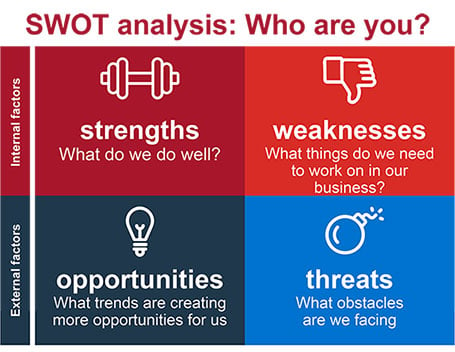
Many companies start with a SWOT analysis, looking at their firm’s strengths, weaknesses, opportunities, and threats. This involves identifying your competitors, understanding exactly how they operate and becoming familiar with their strengths and weaknesses.

Strengths are any competitive advantage, skill, expertise, proficiency, talent or other factors that improve your company’s position in the marketplace and can’t be easily copied. Examples are a well-trained sales team, low staff turnover, high consumer retention or low production costs due to superior technology.

Weaknesses are the factors that reduce your company’s ability to achieve its objectives independently. Examples include unreliable delivery, outdated production tools, insufficient marketing efforts and a lack of planning.

Opportunities are ways for your business to grow and be more profitable. These can include seeking new markets, managing technological change or addressing new consumer trends. You need to look at how your company’s main skills can be used to take advantage of these opportunities.

Threats are barriers to entry in your primary markets, such as a labour shortage, legislative hurdles or detrimental economic or political developments.

Parcours du client

2. Develop a target market profile

Demographic portrait

Here you want to demonstrate that you know your customers inside and out, including their expectations and their whims. Your profile should include basic demographic portraits that paint a clear profile of your clients. Look at characteristics such as age, sex, profession or career, income level, level of educational attainment and geographic location.

Estimated demand

You’ll want to provide research that shows the estimated demand for your product or service as well as the rate at which that demand is expected to grow. This builds confidence within financial institutions that your business has growth potential.

Purchase motivation

It’s also important to understand exactly what motivates customers to buy. Are your clients looking for savings or a way to simplify their lives, for example, or are they just shopping for pleasure? Ask yourself why they would buy your product or service. In the same vein, you may want to know what keeps customers away from your competitors’ products or services. Are they too costly? Do they lack something unique? These insights will help you develop a product or service that outshines the competition.

3. Set clear marketing objectives

Here you describe the desired outcome of your marketing plan with attainable and realistic objectives, targets and a clear time frame.

The most common approach is to use marketing metrics. For example, your market objectives could include:

  • total market share and segments
  • total number of customers and retention rate
  • the proportion of your potential market that makes purchases (penetration rate)
  • the average size or volume of purchases

4. Determine your marketing strategy

Once you’ve determined your objectives and targets, it’s time to look at how you’ll promote your business to prospective customers.

Strategies typically cover the Four Ps of marketing:

  • product
  • price
  • place
  • promotion

Your choice of marketing vehicles will be governed by the profile of your target market, so you need to understand how different vehicles reach different audiences. Don’t always assume you have to spend money on costly advertising. If you have a niche audience, for example, you can take advantage of low-cost marketing strategies such as e-mail.

The costliest options are usually advertising, sales promotions and public relations campaigns. Referrals and networking are lower-cost ways to reach customers. Digital marketing is a powerful strategy because it is inexpensive and effective in reaching target markets.

5. Create your financial plan

A marketing plan without financials has little clout. Financials can also be included in a general business plan.

One document you’ll need to produce is a budget and sales forecast. This doesn’t have to be complex; in fact, it’s wise to keep it simple. It may help to start with the following questions:

  • How much do you expect to sell?
  • What will you be charging?
  • What will it cost to produce your products or deliver services?
  • What will be your basic operating expenses? Be sure to include recruitment costs and salaries here.
  • How much financing will you need to run your business?

Answering these questions will help you determine your projected income and expenses.

A break-even analysis is another important step in developing your marketing plan. This analysis shows exactly how much you need to sell to cover your costs of doing business. If you can surpass your break-even point and easily bring in more than the amount of sales revenue needed to meet your expenses, you stand a good chance of making a profit.