
Loan Mistakes

7 mistakes to avoid when borrowing money for your business

Borrowing too little or too late can jeopardize your business

Getting a business loan can be the fuel your company needs to reach the next level of success.

But you have to prepare yourself and your company to get the money and make sure the loan is right for you.

1. Borrowing too late

You may be tempted to finance your expansion projects from your cash flow. But paying for investments with your own money can put undue financial pressure on your growing business. You may find yourself needing to borrow money quickly and doing it from a position of weakness.

When there’s a sense of urgency, it usually indicates to a banker there was poor planning. It’s often harder to access financing when you’re in that position.

Solution—Prepare cash flow projections for the coming year that take into account month-to-month inflows and outflows, plus extraordinary items such as planned investments. Then, visit your banker and discuss your plans and financing needs so you can line up the funding before you need it.

2. Borrowing too little

You’re right to be careful about how much debt you take on. However, low-balling how much a project will cost you can leave your business facing a serious cash crunch when unexpected expenses crop up.

Solution—Develop a cash flow forecast for each individual project including optimistic and pessimistic scenarios. And then borrow enough money to ensure you can cover your project, unforeseen contingencies and the working capital required to bring your project to completion.

3. Focusing too much on the interest rate

The interest rate on your business loan is important, but it’s far from the whole story. Other factors can be just as important, or even more so.

  • What loan term is the lender willing to offer?
  • What percentage of the cost of your asset is your lender willing to finance?
  • What is the lender’s flexibility on repayments? For example, can you pay on a seasonal basis or pay only interest for certain periods?
  • What guarantees are being asked from you in the case of default? Do you have to pledge personal assets?

There are qualitative items in a loan agreement you have to think through very carefully. Some entrepreneurs will skim over the loan terms and conditions because they think they’re just legal jargon or standard terms requested by all lenders. But the truth is that terms and conditions can differ greatly between lenders.

Solution—Shop around among financial institutions for the most attractive package, keeping in mind the importance of the terms other than the interest rate.

4. Paying your loan back too fast

Many business owners want to pay back their loans as quickly as possible in an effort to become debt-free. Again, it’s important to reduce debt, but doing so too quickly can cost your business. That’s because you may leave yourself short of cash. Or the extra money you’re devoting to debt reduction might be better spent on profitable growth projects.

Solution—Compare your projected return on investment to how much interest you’re saving by paying down your loan faster than required. If you expect to earn more investing the money in your business, consider slowing down your repayment pace.

5. Failing to keep your financial house in order

It’s all too common for busy entrepreneurs to let record-keeping and other financial chores slide—with potentially disastrous consequences. It’s essential to keep good financial records, including year-end financial statements. Messy financial records can leave you in the dark about how your business is performing until it’s too late to take corrective action. It can also make it difficult to approach a banker for a business loan because not only do you lack documentation, but you’ve also shown a lack of managerial acumen.

Solution—Be diligent about keeping financial records and spend the money to hire an accountant. Also, consider getting help from a consultant who specializes in financial management to get your business on the right track.

6. Making a weak pitch to your banker

You can see how much sense your project makes, but you won’t get far if you can’t persuade your banker to get on board. MacKean says too many entrepreneurs are unable to clearly explain their company’s business plan, past performance, competitive advantages, and proposed project. The result is a polite “no, thanks.”

Solution—Prepare your pitch and practice it repeatedly. Focus on explaining your business and how you’re going to use the money you want to borrow in clear and compelling terms. Remember a big part of your sales job is persuading your banker to have confidence in your management smarts and ability to build a strong business (and pay back the loan).

7. Depending on just one lender

Having a relationship with just one financial institution can limit your options, especially if your business hits a bump in the road. You don’t want one lender holding all the cards should something go wrong. So, just as you would diversify your suppliers or customer base, or your own personal investments, you want to diversify your lending relationships.

Solution—Meet with other lenders and consider using different institutions for different types of financing products.


Business Loan

How to prepare a winning business loan application

Preparing an effective, well-documented commercial loan proposal is the first step toward getting the money your business needs from a bank.

Your small business loan proposal will often be the first contact a banker has with your company. So you need to craft a document that presents your business in the best possible light.

The goal is to persuade the banker that you’re ready and able to make a success of your business and repay the loan.

Your business plan is key

The key part of proposals for small business loans is the business plan. Take the necessary time to do a thorough job of preparing it, ensuring it covers the following sections.

  • Executive summary—This section provides a concise overview of your business. It briefly describes your company, its industry, and its competitive advantage. It should also describe the business need or project that requires financing, as well as the amount of money needed.
  • Description of the company—In the main part of your business plan, you should more fully describe the history, current operations and strategy of your business.
  • Management team experience—Show the skills, experience, and qualifications of each member of the management team. Your banker needs to know they have what it takes to make your project work.
  • Key financial data—This section shows the financial strength of your business. Provide financial statements as well as forecasts for the next 2 to 3 years. Your banker will examine this information closely in an effort to understand your track record and capacity to repay the loan. As in every part of your small business loan proposal, make sure you are completely honest and transparent.
  • Marketing plan—Provide a marketing plan to answer these key questions: Is there a proven market for your product or service? Who are your competitors and what are their strengths and weaknesses? What is your client profile? What is your key competitive advantage?
  • Production plan—Your banker will want to know if you have the operational capacity to handle your projected sales.
  • Human resources management—Demonstrate that your business has the ability to recruit, develop and retain the right people to move your business project further.

Include supporting documents

You should bolster your commercial loan proposal by including documents that support, explain and boost the credibility of your plan, including:

  • market studies or other research supporting your conclusions and forecasts;
  • documents to support financial data (e.g. copies of leases, subcontractor estimates, letters of credit);
  • client testimonials; and
  • media reports about your company.

The purpose of the supporting documents is to show your proposal is based on facts.

Tips to write an effective commercial loan proposal

  • Use simple, plain language. Avoid technical terms and acronyms. Your proposal should be clear, well-structured and easy to read.
  • Don’t forget that your proposal’s purpose is to show your company at its best. Sell yourself!
  • Throughout the proposal, focus on showing why your venture will succeed. Demonstrate that you’ve thought of multiple possible scenarios and that you have contingency plans.
  • Image counts. Consider working with a professional to help you to layout the document. If writing isn’t your strength, ask for the help of a professional copywriter or editor.

Marketing Plan

A step-by-step, no-nonsense marketing plan

Every marketing plan should include these five elements

Doing business without a marketing plan is like driving without a map. You may get to your destination—eventually—but you risk making time-consuming and costly errors along the way. You might be assuming there’s a demand for your product when there isn’t, for example. Your services might be priced too low. Or you could be venturing into a market that is impenetrable because of regulatory restrictions.

Marketing plan = confidence

The only way to start a business venture with confidence is to develop a good marketing plan—one that’s backed up with facts and research. This document clearly shows how you’ll attract customers to your product or service and persuade them to buy. The marketing plan also builds confidence with financial institutions, showing lenders that your business has a good chance of being successful.

Contrary to popular belief, a marketing plan is not a one-time effort destined to sit in a binder on your desk. On the contrary, it should be updated on a regular basis to reflect the changing needs of your business and customers.

There are many different models for marketing plans. Here are five essential ingredients.

1. Do a situation analysis

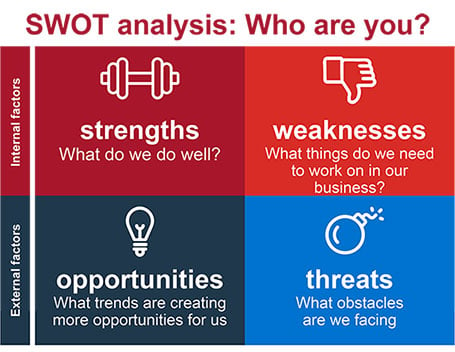
Many companies start with a SWOT analysis, looking at their firm’s strengths, weaknesses, opportunities, and threats. This involves identifying your competitors, understanding exactly how they operate and becoming familiar with their strengths and weaknesses.

Strengths are any competitive advantage, skill, expertise, proficiency, talent or other factors that improve your company’s position in the marketplace and can’t be easily copied. Examples are a well-trained sales team, low staff turnover, high consumer retention or low production costs due to superior technology.

Weaknesses are the factors that reduce your company’s ability to achieve its objectives independently. Examples include unreliable delivery, outdated production tools, insufficient marketing efforts and a lack of planning.

Opportunities are ways for your business to grow and be more profitable. These can include seeking new markets, managing technological change or addressing new consumer trends. You need to look at how your company’s main skills can be used to take advantage of these opportunities.

Threats are barriers to entry in your primary markets, such as a labour shortage, legislative hurdles or detrimental economic or political developments.

Parcours du client

2. Develop a target market profile

Demographic portrait

Here you want to demonstrate that you know your customers inside and out, including their expectations and their whims. Your profile should include basic demographic portraits that paint a clear profile of your clients. Look at characteristics such as age, sex, profession or career, income level, level of educational attainment and geographic location.

Estimated demand

You’ll want to provide research that shows the estimated demand for your product or service as well as the rate at which that demand is expected to grow. This builds confidence within financial institutions that your business has growth potential.

Purchase motivation

It’s also important to understand exactly what motivates customers to buy. Are your clients looking for savings or a way to simplify their lives, for example, or are they just shopping for pleasure? Ask yourself why they would buy your product or service. In the same vein, you may want to know what keeps customers away from your competitors’ products or services. Are they too costly? Do they lack something unique? These insights will help you develop a product or service that outshines the competition.

3. Set clear marketing objectives

Here you describe the desired outcome of your marketing plan with attainable and realistic objectives, targets and a clear time frame.

The most common approach is to use marketing metrics. For example, your market objectives could include:

  • total market share and segments
  • total number of customers and retention rate
  • the proportion of your potential market that makes purchases (penetration rate)
  • the average size or volume of purchases

4. Determine your marketing strategy

Once you’ve determined your objectives and targets, it’s time to look at how you’ll promote your business to prospective customers.

Strategies typically cover the Four Ps of marketing:

  • product
  • price
  • place
  • promotion

Your choice of marketing vehicles will be governed by the profile of your target market, so you need to understand how different vehicles reach different audiences. Don’t always assume you have to spend money on costly advertising. If you have a niche audience, for example, you can take advantage of low-cost marketing strategies such as e-mail.

The costliest options are usually advertising, sales promotions and public relations campaigns. Referrals and networking are lower-cost ways to reach customers. Digital marketing is a powerful strategy because it is inexpensive and effective in reaching target markets.

5. Create your financial plan

A marketing plan without financials has little clout. Financials can also be included in a general business plan.

One document you’ll need to produce is a budget and sales forecast. This doesn’t have to be complex; in fact, it’s wise to keep it simple. It may help to start with the following questions:

  • How much do you expect to sell?
  • What will you be charging?
  • What will it cost to produce your products or deliver services?
  • What will be your basic operating expenses? Be sure to include recruitment costs and salaries here.
  • How much financing will you need to run your business?

Answering these questions will help you determine your projected income and expenses.

A break-even analysis is another important step in developing your marketing plan. This analysis shows exactly how much you need to sell to cover your costs of doing business. If you can surpass your break-even point and easily bring in more than the amount of sales revenue needed to meet your expenses, you stand a good chance of making a profit.

Low-Cost Marketing

7 low-cost marketing strategies to implement now

You know it’s going to take a marketing push to meet your sales goals this year. But your budget is tight and you’ll need to use your imagination to make it. Where to start?

For many business owners, marketing doesn’t come naturally. They lurch from one tactic to another without a clear idea of whether the efforts are going to pay off in higher sales.

If that description sounds familiar, here are some time-tested, low-cost techniques to improve your marketing and help you reach your goals.

1. Conduct a survey

It’s critical to create a marketing plan before moving on to tactics. And the first step in developing a marketing plan is to understand who your target customers are and what they want from your company.

A good way to gain a better understanding of your customers is to conduct a survey about your products or services. If you can’t afford to hire a research company, do it yourself by creating a short questionnaire and recruiting existing and prospective customers to participate.

2. Pamper your existing customers

It’s typically five times as expensive to make a sale to a new customer as it is to an existing one. So make sure you’re not neglecting the people who already know and trust you.

Consider, for example, taking your best customers out to dinner or golf and using the opportunity to ask them about how to improve your business. You could also personally write to your top 10 customers to thank them and tell them they’re part of your new loyalty program or invite them to sneak preview your latest product.

3. Commit to online marketing

The Internet provides you with an inexpensive 24-hour virtual storefront. You can build relationships with prospective customers by offering them high-quality content on your site such as blogs, how-to articles, videos and a newsletter.

You can also extend your reach by using social media. One word of caution, however: If you’re not willing to devote six to eight hours a week of an employee’s time, you’re better off going with a simple, well-designed website.

4. Use all your real estate

Your building and surrounding land or sidewalk are great places to put up signs and banners. And don’t forget to use your vehicles as moving billboards. But remember: Your images and messages should focus on what you’re selling, not your company’s name.

5. Work at public relations

A media story about your company is generally much more valuable than an advertisement because of the credibility it confers on your business. But in this era of media cutbacks, it’s harder than ever to attract journalists’ attention. Keep in mind that they’re looking for a compelling story to tell. So help them by letting them know about your innovative product, unusual customer contact or high-stakes gamble that paid off. And keep at it—building relationships with the media will pay off.

6. Turn employees into ambassadors

Your employees are part of the community and have all sorts of contacts that could help you. How about inviting employees and their extended families to a fun event at your business? You may find you get new word-of-mouth business or hear about a potential new business partner. At the very least, your team will come back to work on Monday feeling energized.

7. Give back

By sponsoring a hockey team or participating in a charity drive with a cheque and a collection jar in your lunchroom or by the cash register, you’re not only doing your part for the community but also generating goodwill with customers and prospects.

Customer Loyalty Program

How to create a customer loyalty program

A good customer loyalty program can generate significant gains in recurring revenue for your business by improving the return on your marketing and sales budget.

Here are some facts:

  • Keeping an existing customer costs up to five times less than winning a new one.
  • It’s easier to persuade a customer who already knows you to buy again and/or buy more from you.
  • 20% of customers are typically responsible for 80% of a company’s revenue.

Is a loyalty program right for your business?

Before developing a customer loyalty program, you need to know whether this will be a useful tactic for your business.

The first thing to determine is the value of a customer to your company and how much it costs to acquire one. This will help you decide whether to invest more money in developing new customers or on retaining and developing the ones you already have.

The value of a customer

Let’s say a good customer at a B2B company buys $30,000 worth of product in a year.

At the same time, you spend $175,000 a year in marketing and business development activities that yield, on average, 10 new customers a year. Therefore, your average customer acquisition cost is $17,500.

If you have several existing customers who don’t spend $30,000 with you in a year, why invest $17,500 in finding a new customer? With a good customer loyalty program, you will most likely boost your sales to existing customers at a much lower cost.

Steps to develop a customer loyalty program

1. Study your current customers

Here are some questions to ask about each customer:

  • How much does this customer buy in a year?
  • What type of products do they buy and how frequent are purchases?
  • How long have they been a customer?
  • Can we sell them other products?
  • Do they use other suppliers, and, if so, who are they?
  • How much profit do we earn on their purchases?
  • How fast do they pay?
  • How satisfied are they with our company?
  • How could we improve our business relationship?

2. Prepare your customer loyalty program

Before launching a loyalty program, you need to assess your customers’ current level of satisfaction through such techniques as surveys, interviews, and monitoring customer comments.

Then, identify employees who are good at dealing with customers and who will be available to participate in the program. You will need to target customers who purchase frequently from you but could become more profitable, according to your analysis. If the purchase cycle is long (more than three years), this type of program is generally not recommended.

3. Set goals, and measure them with a CRM

Set your goals for the program from the beginning. For example, if your customers purchase on average three times per year, set a goal of 3.3 times a year. This will increase your sales by 10% with few additional expenses. Use CRM software to manage this program. If you are looking for a low‑cost or free CRM solution, you may want to consider our list.

4. Set a budget

Set a budget for managing customer retention and a separate one for developing new customers. To do so, consult your industry average if you are looking for above‑average growth, increase your budget accordingly.

5. Decide which customers to target

Based on the study described above, categorize your customers (e.g. A, B, C) according to evaluation criteria that are adapted to your needs and objectives.

  1. Volume of purchases
  2. Ability to purchase more products and services
  3. Speed of payment
  4. Customer profitability
  5. Loyalty over time

6. Choose tactics that will encourage client loyalty

Choose loyalty enhancing tactics that are related to a customer’s purchases, but also to the quality of your business relationship. Here are some examples:

  1. Monthly visits from a sales representative.
  2. Annual visit and business lunch with the vice president of sales.
  3. Personal invitation to a seminar and dinner given by the president.
  4. Premium service—guaranteed 24/7.
  5. Emergency phone line and secure website access.
  6. Additional discounts when purchase milestones are reached.
  7. Sponsorship of an annual event.

2. Prepare your customer loyalty program

Before launching a loyalty program, you need to assess your customers’ current level of satisfaction through such techniques as surveys, interviews and monitoring customer comments.

Then, identify employees who are good at dealing with customers and who will be available to participate in the program. You will need to target customers who purchase frequently from you but could become more profitable, according to your analysis. If the purchase cycle is long (more than three years), this type of program is generally not recommended.

3. Set goals, and measure them with a CRM

Set your goals for the program from the beginning. For example, if your customers purchase on average three times per year, set a goal of 3.3 times a year. This will increase your sales by 10% with few additional expenses. Use CRM software to manage this program. If you are looking for a low‑cost or free CRM solution, you may want to consider our list.

4. Set a budget

Set a budget for managing customer retention and a separate one for developing new customers. To do so, consult your industry average if you are looking for above‑average growth, increase your budget accordingly.

5. Decide which customers to target

Based on the study described above, categorize your customers (e.g. A, B, C) according to evaluation criteria that are adapted to your needs and objectives.

  1. Volume of purchases
  2. Ability to purchase more products and services
  3. Speed of payment
  4. Customer profitability
  5. Loyalty over time

6. Choose tactics that will encourage client loyalty

Choose loyalty enhancing tactics that are related to a customer’s purchases, but also to the quality of your business relationship. Here are some examples:

  1. Monthly visits from a sales representative.
  2. Annual visit and business lunch with the vice president of sales.
  3. Personal invitation to a seminar and dinner given by the president.
  4. Premium service—guaranteed 24/7.
  5. Emergency phone line and secure website access.
  6. Additional discounts when purchase milestones are reached.
  7. Sponsorship of an annual event.

If your customers are businesses, there’s a good chance this type of program is good for you.

But a customer loyalty program doesn’t mean you can neglect new business development. It’s a never‑ending job to increase your portfolio of loyal customers.

CRM

Free and low-cost customer relationship management (CRM) solutions for your business

Contrary to popular belief, customer relationship management (CRM) is not just another type of business management software; it is a business strategy to acquire, grow and retain profitable customer relationships. This distinction is important. CRM can only succeed if the CRM technology supports a truly customer-focused strategy and fits your unique requirements.

How does CRM help?

CRM brings together information about customers, sales and marketing from across your organization. As a result, CRM can help you:

  • retain existing customers by improving customer service
  • sell more to existing customers by uncovering opportunities
  • automate marketing and sales processes
  • better track and manage business performance
  • close deals faster by centrally tracking key information
  • streamline account management by tracking all interactions with each customer
  • enhance pipeline management by tracking performance against sales quotas
  • save time by improving team communication and
  • empower your field sales force with information on their mobile devices.

What does CRM software do?

CRM software captures and organizes information from current and prospective customers in an integrated system. All employees gain a single view of prospects and customers, allowing them to better cooperate and coordinate activities.

Free and low-cost CRM tools

CRM solutions fall into different categories, from online solutions to complex multi-site implementations. If you are looking for a low-cost or free solution, you may want to consider the following. (SaaS refers to “software as a service.”)

This table lists applications alphabetically and isn’t exhaustive. Hyperlinks to external sites do not constitute an endorsement by Aaron Wealth Management of those websites or any information, opinions, products or services expressed or described on them.

Furthermore, the list is only a starting point and excludes applications that are neither low cost nor free. When assessing CRM solutions for your organization, you will probably consider many other factors.