
Coronavirus

Living Through Coronavirus

“Most people who fall sick with COVID-19 will experience mild to moderate symptoms and recover without special treatment” ~ who.in

In January 2020 we heard a virus was emerging from China and soon after people tested positive for Covid-19 also known as Coronavirus. In fact, the first presumptive case reported in Ontario (and Canada) was a man in his 50s, who came from Wuhan, China and begins self-isolating. His wife becomes the second case and begins self-isolating the following day. The man’s illness is officially confirmed two days later.

On February 26, Ontario had 5 confirmed cases of the Coronavirus and people appeared to be unconcerned. We were told to wash our hands frequently, that the seasonal flu virus affected more people each year.

Until this point, most people had a growing concern of the Coronavirus but not panicked until… March 12, 2020, when Doug Ford, Ontario’s premier announced that publicly funded schools across the province will be closed for two weeks following March break. While announcing the decision, the Ontario premier also tells families to: 

travel and have fun

~Premier Doug Ford

When you’re told “have fun” nothing to worry about here, oh and by the way, we’re closing school for 2 weeks, that’s code for “full-blown pandemonium!” I was immediately reminded of the nuclear bomb drills we did at school as a child. Absolute panic and fear of what was to come.

Do you remember in March the frantic race to the grocery store, not to purchase Vitamin C but rolls and rolls of toilet paper. People’s greatest fear was not getting sick but not being able to wipe their butts! Seriously, people waited 2 hours in line to pay $40 for 12 rolls of toilet paper. Stockpiling toilet paper, Kleenex, baby wipes & sanitizers.

Woman builds throne from stockpiled toilet paper

People began saying “stock up on everything. It’s going to be bad, they’re going to close everything.” It was Friday, March 13 my wife and I were grocery shopping as we do every Friday. While I’m not deeply superstitious, it was “Friday the 13th” after all. The grocery store is usually buzzing on Friday but this was crazy!

Grocery store during Coronavirus

There was no meat as you can see and yes no toilet paper or sanitizer anywhere. From this moment on we lived in a different world. This was straight out of a science fiction movie.

Restrictions followed with businesses being closed, wearing a face mask, sanitizing your hands and, working from home. The government issued economic relief cheques to those who qualified and a huge swath of people were unqualified.

The peak of confirmed active daily cases of Covid-19 in Ontario was on April 23/24 with 640 infected people. Contrast that to the highest number of daily confirmed cases of 1,015 on October 15, 2020.
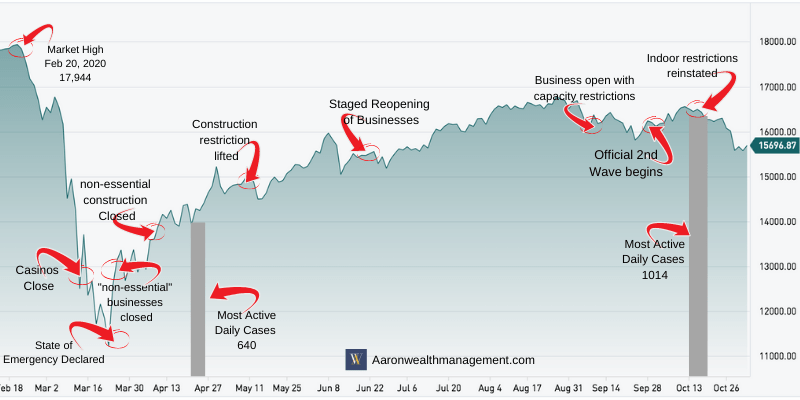
The difference between March and November is we really didn’t know what we were facing and how to deal with Coronavirus. We didn’t know anything about it and in fact the WHO’s direction on what to do changed several times. I’m not placing blame on anyone. We forget these are very difficult things to figure out and in fairness to the doctors and scientists, a great many people had to get sick first in order to determine how it attacks the body.

Case statuses

Despite this people figured out how to survive and live amongst a virus that was and is very deadly for a certain group of people.
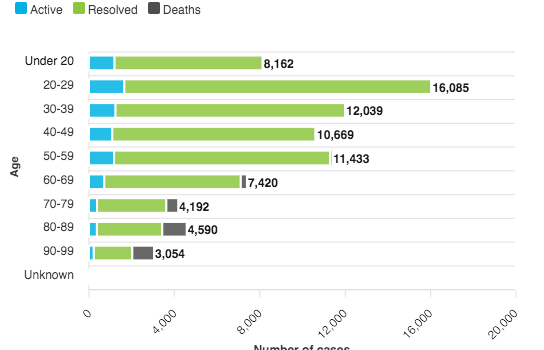
Corona Cases in Canada by age
https://covid-19.ontario.ca/data

The chart above illustrates the number of active & resolved coronavirus cases and deaths. Covid-19 is very dangerous for people with compromised health conditions and the elderly as noted above. The majority of deaths occurred between ages 60-99.

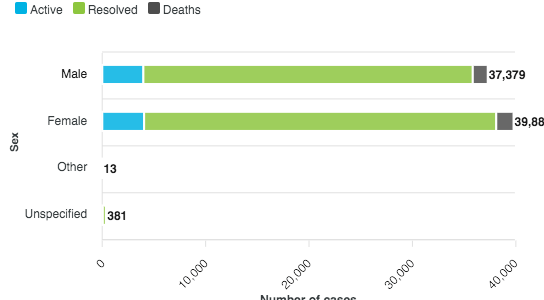
Coronavirus is gender neutral
https://covid-19.ontario.ca/data

Geographical hot spots

The majority of cases are in Toronto and the Peel region. So what does this mean? There are 14.5 million people in Ontario with 2.9 million residing in Toronto. For a great many people Coronavirus has not been a problem. I don’t want to appear dismissive about this. Coronavirus has killed over 10,000 people in Canada.

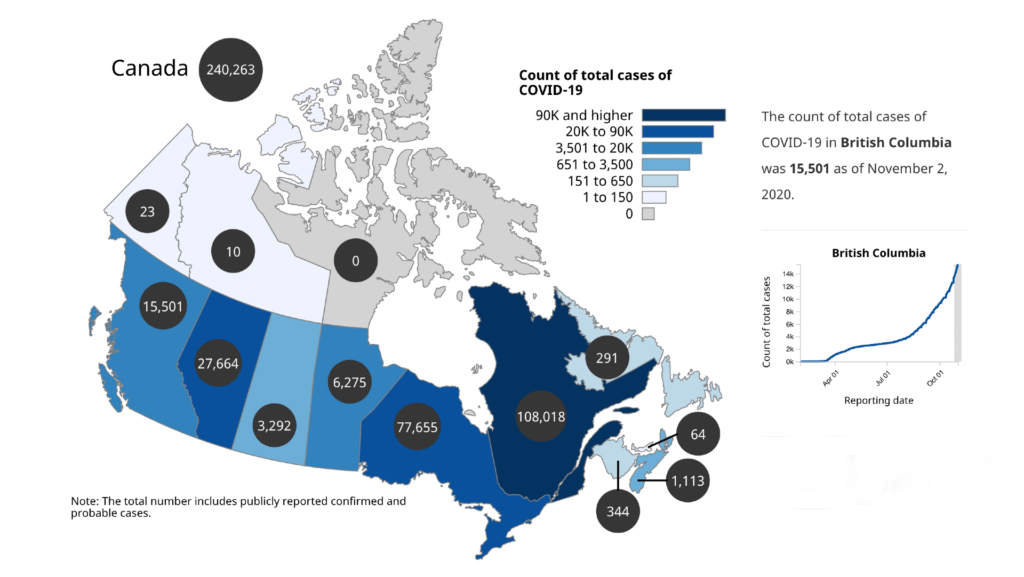
The majority of cases (77.3%) and deaths (92.4%) have been reported by Ontario and Quebec.
Progression of cases over time

Back to the question of living with the Coronavirus outbreak. While the number of Active cases has gone up dramatically since September the number of deaths has not increased at the same rate. At the beginning of the outbreak, we were extremely unprepared and vulnerable. The province has done an excellent job of educating everyone on how to protect those who are most at risk of contracting the Coronavirus.

Coronavirus Deaths

Coronavirus New Cases

What is significant about the graphs above, is the contrast between new cases in November being nearly double the new cases at the highest point in April when the province was locked down. At the peak of new daily cases (640) on April 24, there were 50 deaths as compared to October 31 with 1,014 new daily cases and 9 deaths.

What this tells me is we understand how to live with the Coronavirus, how to protect ourselves and the people we love without the province being in lockdown. Everywhere I’ve gone in the GTA people are doing there part to keep safe:

  • Wearing a face mask
  • Sanitizing their hands, even the items they purchase
  • Utilizing hands-free door openers
  • Maintaining separation of at least 2 metres
  • Avoiding unnecessary travel
  • Learning how to work with digital products to conduct business

People have decided they can continue to work and to be social in a safe way. They have the tools, knowledge, and experience to move forward with their life without endangering others, especially those among us who are most vulnerable.


20200204_header

Unintended Consequences of Taking Corp Dividends vs. Taking a Salary

Most business owners think about how to save taxes on their personal income by taking Corporate Dividends however, you’re missing out on planning solutions that could save you hundreds of thousands of dollars in taxes and future value of your retirement income.

How often have I talked with a business owner and been informed they only take dividends from their corporation versus taking a salary. Do they also know taking dividends means they cannot make CPP contributions? The argument is that this strategy lowers taxes owing and you negate having to pay CPP premiums.

Let’s contemplate a retirement without CPP. To keep the math simple let’s assume inflation and discount rates are equal. Don’t think the Canada Pension Plan & Old Age Security are important to your retirement (especially with the recent CPP enhancement)? Consider this, the present value of the maximum CPP benefit for a 65-year-old over 20 years is $282,199, and for a couple, that’s $564,398!

By paying yourself a Corporate Dividend, you’re giving up

$564,398 of retirement income!

~ David Aaron

If a business owner does decide to go the dividend route, they should consider how they are going to replace the CPP income. Obviously, that means saving more.

A compromise might be the best solution to try and get the best of both worlds. The business owner could pay themselves a salary equal to the Yearly Maximum Pensionable Earnings ($58,700 for 2020). This way they can contribute the maximum to CPP and create some RRSP room.

They could also save in the business corporation so that the CPP benefit can be replaced by dividends in the future.

What else are you losing out on by paying yourself a Corporate Dividend?

Registered Retirement Savings Plan (RRSP)

Taking a salary also creates RRSP contribution room, which is deductible from your personal income and allows you to save and invest in a tax-sheltered account. While I don’t automatically endorse the use of RRSP’s for business owners, they are a useful retirement planning tool given all other options are exhausted.

Individual Pension Plans

Arguably the most powerful retirement savings solutions for incorporated business owners provided they qualify. Individual Pension Plans provide the mechanism to move cash off the corporate balance sheet which otherwise could be subject to Passive Income Tax, and into your personal pension plan.

The catch here is, you must be incorporated and corporate dividend income does not qualify as income used to calculate your eligible contributions. Only Salary income can be used in the calculation for pension contributions.

One of the key advantages of an IPP (besides increasing your retirement assets by as much as 65 % more than an RRSP) is creating large tax deductions for your corporation. Especially in the case of selling your business, the deductions could wipe out all or significantly reduce the amount of taxes owed to CRA.

Here are a few benefits:

  • An excellent way to increase your retirement assets and have your company make large tax-deductible contributions
  • Allows for significant additional tax-deductible contributions at inception and retirement
  • Tax-deductible unused room (Past Service) contributions from your company, up to $900,000+
  • All costs associated with the pension plan are tax-deductible to the company

Tax-Exempt Corporate Whole Life Insurance

Tax-Exempt Corporate whole life insurance could also fit the bill here, giving the corporation access to cash for business opportunities or challenges in the future. The key benefit of using corporately owned life insurance is creating a tax shelter. Moving cash off the balance sheet which could be subject to passive income tax, and into a Tax-exempt corporate life insurance policy. Growth within an exempt life insurance policy will not affect a CCPC’s passive investment income earnings under the new passive income rules.

Long-term planning is required for this strategy to be an effective tool in providing an income stream during retirement or to use as leverage against a loan.

Personal Credit

Finally, having salary income will help you with a mortgage application, if you intend to buy a house. The banks don’t consider dividend income as stable when looking at how much of a mortgage you can afford.

Bottom Line

Once you’ve set aside as much savings as possible inside your corporation, I recommend drawing salary to fund your lifestyle needs. This will maximize your CPP contributions and your RRSP contribution room, along with some of the other benefits mentioned. This recommendation may change in years to come since tax rates are constantly changing, but for now, salary is the clear winner.

Divorce and Tax Free Savings Accounts

Divorce and Tax Free Savings Accounts

The majority of marriage breakdown occurs between September and New Year’s Day. In fact, the first Monday after Christmas or New Year’s Day is when married couples would settle on a split, and when September ends is when separations are most commonly agreed upon.

Divorce can often have devastating financial consequences for one or both parties. If you’re required to pay as part of your separation agreement or divorce, consider carefully which accounts to use.

The two most common savings accounts for Canadians are Tax Free Savings Accounts (TFSA), and Registered Retirement Savings Plans (RRSP).

Do Not Do Make a Withdrawal from Your Tax Free Savings Account to Pay for a Marriage Breakdown

When there is a breakdown in a marriage or common-law partnership, an amount can be transferred directly from one individual’s TFSA to the other’s TFSA without affecting either individual’s contribution room. 

The transfer must be completed directly between the TFSAs by the issuer. If you are in this situation, you must meet both of the following conditions: 

  • you and your current or former spouse or common-law partner were living separate and apart at the time of the transfer 
  • you are entitled to receive, or required to pay, the amount under a decree, order, or judgment of a court, or under a written separation agreement to settle rights arising out of your relationship on or after the breakdown of your relationship 

When these conditions are met, the transfer is a qualifying transfer and will not reduce the recipient’s eligible TFSA contribution room. Since this transfer is not considered a withdrawal, the transferred amount will not be added back to the transferor’s contribution room at the beginning of the following year. 

Also, the transfer will not eliminate any excess TFSA amount, if applicable, in the payer’s TFSA.

How to pivot your business

When and How to pivot in business

When changes occur in consumer trends and needs, it can be a good time for small business owners to alter or pivot their operations to better serve customers and the core values of their business. You’re probably not surprised to hear that new research shows COVID-19 has impacted consumer behavior. According to McKinsey, consumer behavior will continue to evolve with the long-lasting impact from the pandemic. This means that small businesses that can adapt in response to the changing needs of consumers have the best chance for survival.

What is a pivot in business?

When a small business owner makes dramatic changes to their original business focus, it’s referred to as pivoting a business. This usually includes a change in the business model, altering what the business does to earn a profit. For example, a restaurant may begin offering pickup or delivery options, or a gym may add online classes to their existing in-person membership offering.

Small businesses that can adapt in response to changing market needs have the best chance for survival. The Harvard Business Review called adaptability the new competitive advantage in 2011. A recent study released by Advantage | ForbesBooks found that the adaptability quotient (AQ) of a business plays a critical role in its ability to survive.

When to pivot in business

To determine whether you should pivot your business, you’ll need to identify your business’s core competencies, conduct market research and complete a competitive analysis. Follow these steps to determine whether and how you should pivot.

Step #1: Identify your business’s core competencies.

Consider what gives your business a competitive advantage. Core competencies are typically difficult to duplicate, allowing you to serve your customers in unique ways. The Balance Small Business notes that successful businesses tend to have more than one core competency. Some examples include quality, customer service, value, innovation and marketing.

Step #2: Anticipate and forecast market needs and emerging trends.

This is an important step in determining the long-term viability of your business. CB Insights found that 42% of startups fail because their business does not serve a market need. A market need refers to a functional or emotional need or desire of your target audience.

Step #3: Know your customers.

Successful small businesses can identify what people want or need and then create products or services that meet those wants and needs. As consumer preferences change, businesses must adapt their offerings to stay relevant and continue to earn revenue.

  1. Market research — This involves gathering and analyzing information related to consumer needs and preferences. Conducting market research can help you determine existing and emerging needs and the viability of your business in its current state. It can also help you start thinking through ideas for pivoting. To get started, here are a few questions to get you moving in the right direction:
    • Is there a desire for your product or service?
    • How many people would be interested in what you’re offering?
    • Where do your customers live? Can your business reach those customers?
    • How many similar options are already available to consumers?
    • What do consumers pay for similar options?
  2. Emerging trends — These can include market responses to technological advances as well as major national or global events, such as an economic downturn or pandemic. There are many resources you can use to discover trends, including:
    • Google Trends: Find topics people are searching for online. Discover upward or downward trends that could relate to customer needs.
    • McKinsey & Company: Access insights related to issues in business and management.
    • Forbes: Find stories on marketing trends, along with advice for entrepreneurs.
    • Mintel Trends: Discover research on trends impacting all industries and within select industries, such as beauty or food and drink
    • Small Business Trends provides a larger list of resources.

Step #4: Know your competition.

A competitive analysis allows you to learn from businesses competing for your potential customers. By identifying your competitors’ strengths, you can pinpoint your business’s unique strengths. Identifying your business’s unique competitive advantage will help you determine the need to pivot your business. Small Business Trends provides a great resource detailing various methods and tools to complete a competitive analysis.
  
Conducting market research and competitive analysis can help you formulate ideas for pivoting your business. Pivoting your business does not mean you need to give up on your company’s core values — the guiding principles and beliefs that help you and your employees work toward a common goal.

Develop a “pivot plan” for future success.

Finally, develop a plan to pivot. Changing market trends may suggest a need for a short-term or long-term pivot.

  • Many small businesses have made short-term pivots during the COVID-19 pandemic. Distilleries are using their resources to create hand sanitizer. Restaurants are offering takeout and delivery options.
  • Economic and market trends can create long-term impacts on consumer needs and wants. A long-term pivot serves the lasting needs and wants of your target market. For example, a retailer with physical stores may pivot to selling exclusively online.
  • A strategic plan will help you implement a pivot. A strategic plan documents your future vision for your business. It details your business’s current state, desired future state and a plan for how you’ll evolve your business over time to land at your desired future state. For more information, visit SCORE’s guide on how to craft a strategic plan.

Adaptation is necessary for business survival, and the ideas for pivoting your business should be supported by your core competencies. You can stay true to the business you’ve built with the values you’ve built it on while also pivoting your business to ensure long-term success.

Toronto Wealth Management

Local marketing & advertising strategies

According to the Small Business Administration, a third of businesses with employees don’t survive beyond two years. But once you’ve made it through the difficult startup period and your business is on sound footing, it’s time to think about expanding locally. 

Building out your business can lead to sales growth that allows you to stay ahead of the competition. Expansion can be risky and increase debt, and it takes time and resources. But the potential rewards can be worth the effort. With sound planning and execution, it’s a manageable task. A sound marketing strategy is key, allowing you to build awareness of your brand in the public eye. That can even lead to an increase in customers. 

Conduct market research and formulate a plan

Start by conducting market research. While this may sound costly or complicated, it can be as easy as talking to your customers about your products and services or asking them to complete a short survey. For Internet companies and e-tailers, there’s free or inexpensive online software that enables you to email questionnaires to your customer list. 

Once completed, use the valuable customer feedback to assemble a marketing plan, such as what the Small Business Administration outlines. The information will help you understand your target market and your competitive position within that market. You’ll be able to better tailor your message to your customers while choosing the best medium for reaching them. 

Also, a marketing plan will help you stick to your overall growth plans and keep you on budget and on track for timely, prudent spending of your marketing resources.

Head online for local advertising

Your company website will serve as one of your primary marketing tools. It’s a virtual storefront for online customers, whether you’re selling products or services. Ensure your site is up to date, easy to navigate and has a design best representing your business. If a large portion of your business occurs online, consider creating a mobile app to allow your customers to shop with their smartphones, or at least develop a responsive, secure website. A well-made app can make for an easier, more interactive shopping experience.

With a company website and app, you can take advantage of marketing opportunities by adding navigation software that allows you to track a customer’s visit to your online business. You can automatically send related product suggestions based on their searches or create online tools to deliver coupons, special offers or one-time sales promos. Offering loyalty or club cards can encourage return visits.

Free enterprise and social media

One sure way to stay on budget is to take advantage of as many free marketing opportunities as you can. For instance, Google My Business allows you to set up an account listing vital business info, including your address, phone, hours of operation, website link, business description and even a photo. This ensures the correct details appear in online searches and can give your business a boost in search rankings. 

Establish accounts on popular social media platforms such as Facebook, Twitter and Yelp, which offer excellent opportunities for engaging with customers and advertising special events or offers. It’s important to check on the sites regularly and post updates on a consistent basis. Another strategy for building traffic to your website is to add a blog where you can post news, tips and articles on subjects related to your business.

Paid media

Traditional marketing methods have long helped owners grow their businesses and should be an important consideration for any local marketing strategy. Although marketing is increasingly shifting to the internet, purchasing an ad in a local newspaper can still be the best way to reach a target audience if you run a retail outlet such as a furniture store.

To promote specialized products, consider advertising in specialty magazines or trade publications. If you want to better gauge the ad’s effectiveness, include a coupon or discount for subscribers that they can redeem at your business.

A similar strategy is to buy local advertising spots on a TV or radio channel. Your local station’s ad sales team should be able to provide information on its listeners, including detailed demographics and audience size at each point in the day, to help you choose the best program and time slot for your ad. Flyers and coupons sent via direct mail are another option for businesses interested in reaching a wide audience.

Paid digital marketing

Digital advertising is a logical part of any marketing plan. It can seem complicated, but a well-placed digital ad can reach the largest audience in the shortest amount of time. 

Consider advertising with the online version of your city newspaper or another local news website or popular blog. For a more targeted approach, advertising through business services that some of the largest social media companies now provide and some smaller ones can also ensure you reach a desired group. 

A Facebook business account allows you to pinpoint a demographic and choose the frequency of your posted ads. Likewise, Google AdWords targets your ads according to a user’s online searches. Both companies provide analytics for you to see precisely the effectiveness of your ads.

Whatever your approach to marketing and advertising, growing a business is an exciting time. Acquiring property, liability or business interruption coverage, can give you the confidence to focus on growth.

Protecting Your Small Business from Hackers

How to protect your small business from hackers

There have been numerous reports of rising threats to small businesses at the hands of cybercriminals. It’s a growing problem as small businesses struggle to protect themselves, mitigate breaches and, in some cases, remain functional.

What the statistics show

A recent survey found that only 9 percent of business owners admit their business was a cyberattack victim, but when given a list, 50 percent say their business has experienced at least one type of harmful cyber activity. Also troubling is that 64 percent do not have a dedicated employee or vendor in charge of detecting and combating cyberattacks. Clearly, this needs to change.

A report by FireEye and Marsh & McLennan Companies found that, on average, businesses take 146 days to detect a cyberattack. Think of the damage that can be done in that time.

Why small businesses are uniquely vulnerable

Small businesses are vulnerable because they simply don’t have the resources that large corporations do. The big companies can afford the best protections and dedicated staff to ensure that systems and data are safe, but this can prove to be much more challenging for a small business — especially one struggling to keep the doors open.

Cybercriminals understand this and target small businesses as a result. It’s often much easier for them to penetrate a small business’s security or move on and find the next one with its guard down. As security solutions provider TrendMicro notes , “For many SMBs, watching the budget is necessary to keeping the lights on and ensuring the business lives to operate another day. This leaves very little room for other initiatives or unexpected costs. Unfortunately, this lack of funds shows often in the security solutions that SMBs implement. Some organizations have the basics while others don’t have anything at all, relying on their size to avoid the attention of cybercriminals.”

Scot Ganow, co-chairman of the Privacy and Data Security practice group at Taft Stettinius & Hollister LLP, thinks companies simply don’t understand why cybercriminals target small businesses. “They mistakenly think they do not have the data the bad guys would want, are not big enough, or are not located in a big city where such hacks occur,” he says. “A company’s size and location are often irrelevant to why an attack is launched.”

What cybercriminals target within small businesses

A recent survey found that half (50 percent) say their business has experienced at least one type of harmful cyber activity: computer virus (27 percent); phishing (25 percent); Trojan horse (9 percent); ransomware (7 percent); hacking (6 percent); unauthorized access to customer information (6 percent); unauthorized access to business information (6 percent); issues due to unpatched software (6 percent); and data breach (6 percent).

A CloudNexus report indicates that the data at most risk within small businesses include: authentication data, personal health information, credit card information, proprietary data, social security numbers and financial transactions.

How to protect your small business from hackers

Regardless of how insignificant you think your company is to a criminal’s plans, you never know what kind of data they may be seeking from you or what they plan to do with it. But there are steps you can take to prepare against hackers, including:

  • Educating employees on the proper protocol when opening attachments or sending sensitive information
  • Performing background checks on employees to ensure that they do not have a cybercriminal history
  • Backing up data so that any lost information can be recovered
  • Ensuring your computers, servers, and other electronics are secure with the right firewalls and virus protection programs
  • Protecting your business with security solutions and cyber liability insurance